
If you are planning a borehole for your home, one of the first questions you will ask is simple: how much is this really going to cost? The answer depends on more than just drilling. Depth, geology, casing, pump choice, tank size, filtration, labour, electrical work, plumbing, and testing can all affect the final price.
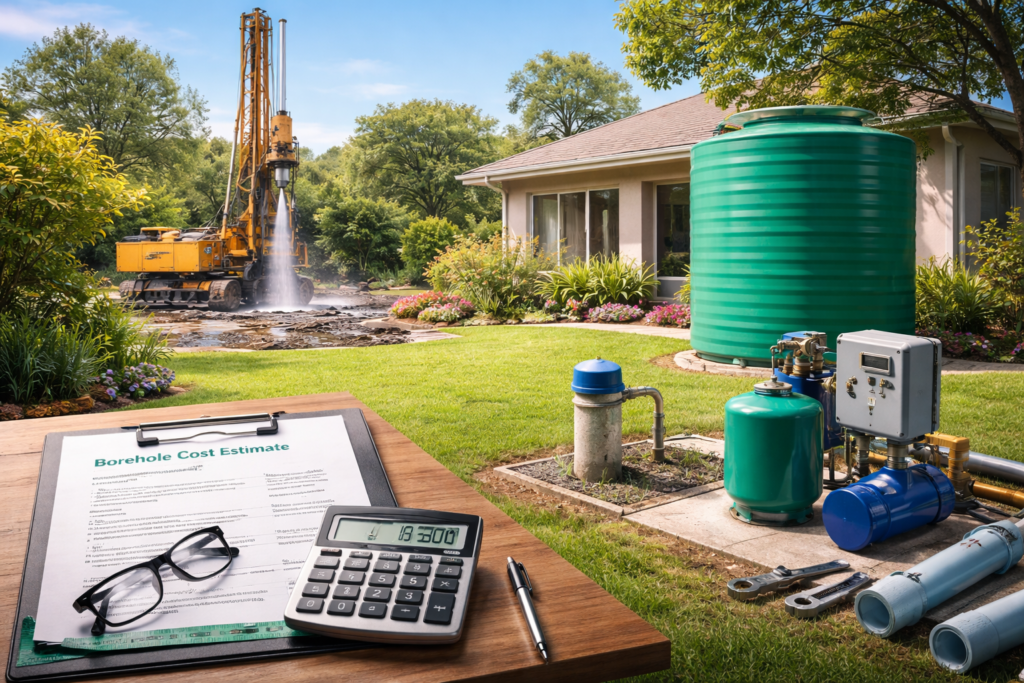
This borehole cost calculator South Africa helps you build a realistic estimate before you request quotes. It is designed for South African homeowners who want a clearer view of what a borehole project could cost, whether you are still in the research phase or already comparing contractors.
Use the calculator below to estimate your likely total cost, then read the sections underneath to understand how the estimate works, what can change your final quote, and which related guides to read next.
Borehole Cost Calculator South Africa
Estimate drilling, casing, pump, tank, filtration, installation, testing, and connection costs with a cleaner real-world planning tool.
Inputs
Compare scenarios
Municipal vs borehole
Get real quotes
How This Estimate Works
This calculator is built to give you a practical planning estimate rather than a contractor’s final quote. It combines the main cost areas that usually shape a residential borehole project in South Africa.
The first part of the estimate is the drilling cost. This is usually based on the expected depth of the borehole and a drilling rate per metre. The deeper the hole needs to be, the higher this part of the project cost will normally be.
The second part is casing. In many cases, some section of the borehole will need casing to support the structure and protect the installation. The calculator includes a casing allowance because this can be a meaningful part of the project, especially where conditions require more support.
Next comes the working water system. That may include a pump, pressure system, storage tank, and filtration. Some homeowners want only a basic setup that brings water to a tank. Others want a fuller system that feeds the house, improves pressure, and adds water treatment. That is why the calculator includes equipment choices and pricing modes.
It also includes common extra costs such as site survey allowances, yield testing, water testing, electrical connection work, plumbing connection work, and an optional contingency buffer. These are often forgotten when people focus only on the drilling price.
In other words, the calculator is not just trying to answer “what does drilling cost?” It is trying to answer the better question: “what could my full borehole project cost once the system is actually usable?”
What Can Change Your Final Quote
No calculator can predict every site perfectly. Final borehole pricing can change for several reasons, and understanding these factors will help you compare quotes more intelligently.
1. Depth and Geology
The depth needed to reach a reliable water-bearing zone is one of the biggest cost drivers. Hard rock, mixed ground, unstable formations, and deeper drilling can all increase the final price. Two properties in the same suburb can still have very different drilling conditions.
2. Water Yield
A borehole that produces enough water for household use is more valuable than one with a poor yield. If the yield is lower than expected, you may need to adjust your system design, storage capacity, or household water strategy.
3. Casing Requirements
Some sites need more casing than others. If ground conditions are loose or unstable, the contractor may need to install more support than originally expected. That can increase both material and labour costs.
4. Pump and System Size
A simple setup for garden use or tank filling will usually cost less than a system designed to supply a full home. Larger households, higher water demand, multi-bathroom homes, irrigation needs, and higher pressure expectations can all push system costs up.
5. Tank, Filtration, and Pressure Choices
The bigger the tank, the more you will usually pay. The same applies to pressure systems and filtration. A basic setup may work for some homeowners, while others want better pressure, better storage, and more advanced filtration for household use.
6. Electrical and Plumbing Work
Even if the borehole is drilled successfully, the system still needs to be connected properly. Electrical cabling, control equipment, pipe runs, fittings, valves, and integration with the home’s plumbing can all add to the final quote.
7. Testing and Commissioning
Yield testing and water quality testing are important because they tell you what the borehole can produce and whether the water is suitable for its intended use. These items may be optional in some quotes and included in others, so always check carefully.
8. Site Access
Access matters more than many homeowners expect. Tight spaces, difficult driveways, sloped sites, obstacles, and restricted working areas can increase labour and project complexity.
9. What the Quote Actually Includes
Some contractors quote only for drilling. Others include parts of the pump installation, testing, or casing. That is why two quotes can look very different at first glance. Always compare what is included line by line.
FAQ
Is this calculator accurate?
It is accurate as a planning tool, but it is not a final contractor quote. It helps you estimate the likely total cost of a borehole project based on the choices you make in the calculator.
Does the calculator include only drilling?
No. It is designed to estimate more than drilling alone. It can include casing, pump setup, tank costs, filtration, pressure systems, testing, labour allowances, and connection work.
Why does my quote differ from the calculator result?
Contractor quotes can differ because of geology, actual borehole depth, casing requirements, water yield, equipment brand, site access, labour scope, and what the contractor includes or excludes.
Should I use budget, standard, or premium mode?
Use budget mode if you want a simpler starting estimate, standard mode for a typical household planning estimate, and premium mode if you expect a larger or more complete system with higher equipment and installation costs.
Can I rely on the drilling rate per metre shown in the calculator?
You should treat it as a useful default, not a fixed rule. Local conditions and contractor pricing can vary. That is why the calculator allows you to adjust the drilling rate manually.
Does a borehole always need a tank?
Not always, but many homeowners include storage because it makes the system more practical and flexible. A tank can help manage supply, pressure, and household usage patterns.
Do I need filtration?
That depends on how you plan to use the water and what water testing shows. Some setups use very basic filtration, while others need more treatment for household use.
What should I do after using the calculator?
Use the estimate to set your expectations, then request detailed quotes from borehole contractors. Ask exactly what is included, what is excluded, whether testing is included, and whether pump, tank, plumbing, and electrical work are quoted separately.
Related Borehole Cost and Equipment Guides
Read these guides next if you want a deeper understanding of borehole pricing, drilling, and system costs:
- How Much Does a Borehole Cost in South Africa?
- How Much Does Borehole Drilling Cost Per Meter in South Africa?
- How Borehole Drilling Works
- How Deep Should a Borehole Be in South Africa?
- How Much Water Can a Borehole Produce in South Africa?
If you are still comparing options, use the calculator above first, then work through the related guides so you can request quotes with a much better understanding of the real costs involved.