
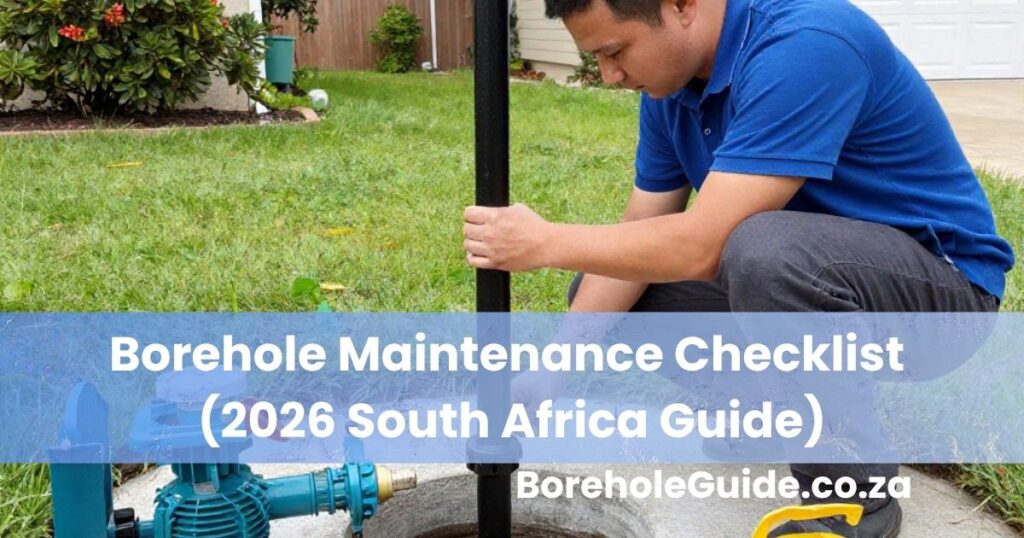
A borehole can be one of the most valuable assets on a South African property. It gives homeowners more control over their water supply, reduces dependence on municipal systems, and can create long-term savings when managed correctly. But one of the biggest mistakes homeowners make is treating a borehole as a one-time installation rather than an ongoing system that needs structured care.
A borehole is not just a hole in the ground with a pump attached. It is a working water system made up of underground components, mechanical parts, electrical controls, storage, filtration, and plumbing connections. Every one of those parts can wear down, become blocked, lose efficiency, or fail if it is ignored for too long.
That is why a proper borehole maintenance checklist matters. Regular maintenance helps you protect water quality, extend the life of your pump, catch problems early, reduce electricity waste, and avoid expensive repairs. It also helps you maintain steady water pressure and reliable output over the long term.
This guide gives you a full authority-level checklist for maintaining a borehole in South Africa. It covers what to inspect monthly, what to service quarterly, what should be checked annually, and what warning signs you should never ignore. It also explains the practical side of borehole ownership, including common problems, costs, and best practices that can help your system last 20 to 30 years or more.
👉 If you are still comparing setup costs, start with our guide on borehole costs in South Africa.
Table of Contents
- Why Borehole Maintenance Matters
- Understanding Your Borehole System
- Recommended Maintenance Schedule
- Monthly Borehole Maintenance Checklist
- Quarterly Borehole Maintenance Checklist
- Annual Borehole Servicing Checklist
- Borehole Pump Maintenance Guide
- Water Quality and Filtration Maintenance
- Storage Tanks, Pressure Systems, and Plumbing Checks
- Warning Signs Your Borehole Needs Attention
- Borehole Maintenance Costs in South Africa
- Common Maintenance Mistakes Homeowners Make
- How to Extend Borehole Lifespan
- FAQs
Why Borehole Maintenance Matters

Many homeowners only think about maintenance after something goes wrong. That approach usually costs more. A borehole system often gives warning signs before major failure happens, but those warning signs are easy to miss if you do not have a routine.
Maintenance matters for three main reasons: performance, water quality, and cost control.
From a performance point of view, a borehole that is maintained properly will usually deliver more stable water pressure, more reliable output, and fewer interruptions. Filters remain cleaner, pumps work more efficiently, and pressure systems stay balanced. That means less strain on the system as a whole.
From a water quality point of view, maintenance helps ensure that the water entering your home remains suitable for its intended use. Groundwater conditions can change over time. Sediment can increase. Iron content can become more noticeable. Bacteria or contamination risks may arise if storage or filtration systems are neglected. Testing and filter maintenance are essential if you use the borehole for household supply.
From a cost point of view, maintenance is usually far cheaper than repair. Replacing filters, testing water, checking electrical controls, and servicing a pump on time costs much less than dealing with a burnt-out motor, blocked pipework, or a failing pressure system. Preventive maintenance is almost always the cheaper route.
👉 Related reading: Hidden Costs of Borehole Drilling Homeowners Forget.
Understanding Your Borehole System

If you want to maintain a borehole properly, it helps to understand what you are actually maintaining. A standard residential borehole system may include the borehole shaft itself, a submersible pump, delivery pipes, non-return valves, a control box, electrical connections, filters, storage tanks, pressure pumps, pressure vessels, and plumbing into the property.
The underground part of the system is easy to forget because you cannot see it every day. But that underground section is where some of the most expensive components live, especially the pump and rising main. If the pump is overworked, runs dry, or becomes electrically unstable, you may only notice the problem once water pressure drops or the water stops entirely.
Above ground, filters and tanks often get ignored because they seem passive. In reality, they are central to good system health. A blocked filter can reduce flow and force the pump to work harder. A dirty storage tank can affect water quality. A badly adjusted pressure switch can cause constant pump cycling, which shortens pump life.
Once you understand that all of these parts are connected, maintenance becomes more logical. You are not just cleaning or inspecting random parts. You are protecting a complete water delivery system.
👉 For pump-related costs and context, see Borehole Pump Installation Costs Explained.
Recommended Maintenance Schedule
A good maintenance plan is built around intervals. Not everything needs to be checked every week, but some things should never be left for years. In most residential setups, a practical schedule looks like this:
| Maintenance Task | Recommended Frequency |
|---|---|
| Visual checks and performance monitoring | Monthly |
| Filter, pressure, and system inspections | Quarterly |
| Water quality testing | At least annually |
| Professional servicing and technical inspection | Every 12 to 24 months |
The exact schedule depends on how heavily the borehole is used. A borehole supplying a large household, irrigation system, or multiple buildings may need more frequent attention than one used only for light backup supply. Water chemistry also matters. If your groundwater has high sediment, iron, or mineral content, filters and related equipment may need more frequent maintenance.
Monthly Borehole Maintenance Checklist

Monthly maintenance is about early detection. You are looking for changes in performance before those changes become failures.
1. Check water pressure and flow consistency
Turn on taps or irrigation outlets that normally receive borehole water and pay attention to any obvious changes. If pressure is weaker than usual, flow pulses irregularly, or the system takes longer to build pressure, something may be changing inside the system. That change could be related to filters, valves, leaks, pump wear, or pressure settings.
2. Listen to pump behaviour
Even if the submersible pump itself is out of sight, you can often hear clues through the control system or pressure pump setup. Unusual clicking, rapid on-off cycling, humming, or repeated restarts are signs that deserve attention. A healthy system usually behaves consistently. Sudden changes in sound or operating rhythm are worth investigating.
3. Inspect visible pipework and fittings
Walk around the accessible parts of the system and look for leaks, damp areas, corrosion, cracked fittings, loose joints, or drips around valves and couplings. A small leak may not seem serious, but over time it reduces efficiency and can cause the pump to work harder than necessary.
4. Check the control box and visible electrical points
Look for obvious warning signs such as moisture, burn marks, loose cables, damaged insulation, or tripped protection devices. Do not open electrical panels unless you are qualified to do so, but do inspect visible signs of trouble. Electrical instability is a major cause of pump problems.
5. Observe water appearance
Pay attention to whether the water looks clean, cloudy, sandy, discoloured, or oily. Any visible change in water appearance should be noted. Even if the water is not used for drinking, water quality changes can indicate sediment movement, casing issues, or filtration problems.
6. Monitor tank cleanliness and water level behaviour
If your system uses storage tanks, check that they are filling and emptying normally. Sudden changes in refill time can indicate reduced borehole output or pump inefficiency. If the tank interior is visible, watch for sediment buildup, algae, or unusual residue.
Quarterly Borehole Maintenance Checklist

Quarterly maintenance goes deeper than the monthly routine. This is the stage where you clean, test, adjust, and verify system efficiency.
1. Clean or replace filters
Filters are one of the most overlooked parts of a borehole system. Sediment filters, cartridge filters, spin-down filters, iron filters, carbon systems, and other treatment units all require attention. If filters clog, flow drops, pressure suffers, and the pump has to work harder. Follow the manufacturer’s replacement intervals, but also respond to actual conditions. In high-sediment systems, waiting too long can cause major performance loss.
2. Inspect pressure tank and pressure switch operation
If your system includes a pressure vessel and switch, confirm that the cut-in and cut-out behaviour is normal. Constant short cycling often points to pressure problems, waterlogging in the vessel, or switch settings that need adjustment. These issues can reduce pump life significantly if ignored.
3. Check non-return valves and isolation valves
Faulty valves can cause water to drain back, pressure to collapse, or the system to re-prime too often. Inspect accessible valves for leaks, noise, or inconsistent behaviour. A valve problem can look like a pump problem if you do not trace it properly.
4. Review irrigation and high-demand use patterns
If your borehole also supports irrigation, check whether demand has increased beyond what the system was designed to handle. Overuse can reduce recovery time and strain the pump. Seasonal irrigation often changes how hard the borehole has to work, so quarterly reviews are useful.
5. Inspect tank lids, vent screens, and overflow points
Storage tanks should remain closed, secure, and protected from contamination. Broken screens, loose lids, or poorly managed overflow points can let in insects, debris, dust, or contamination. This is especially important if the stored water is used inside the house.
Annual Borehole Servicing Checklist
Annual servicing is where preventive maintenance becomes serious technical maintenance. Even if your system seems fine, a yearly service can reveal developing issues before they become expensive.
1. Test water quality professionally
At minimum, you should test for the parameters that matter for your intended water use. That may include microbiological safety, pH, conductivity, iron, manganese, total dissolved solids, hardness, and other relevant indicators. If the water is used for drinking or household supply, annual testing is strongly recommended.
2. Assess borehole yield and recovery behaviour
If there is concern about declining performance, a professional can test the system’s output and recovery rate. This helps determine whether the issue lies with the aquifer, the pump, the delivery system, or the treatment equipment. It is far better to diagnose a yield problem early than to keep forcing the system to compensate for it.
3. Inspect pump performance and electrical load
Professionals can measure whether the pump is operating within normal ranges. Electrical draw, pressure performance, and flow output can reveal a lot about pump condition. A pump that is starting to fail may still run, but less efficiently. That inefficiency shows up in higher electricity use and weaker performance.
4. Flush or clean where necessary
Some systems benefit from line flushing, tank cleaning, or filter housing sanitation. If sediment or biofilm has built up, targeted cleaning helps restore system hygiene and performance.
5. Review the full system as one unit
Annual servicing is also the right time to review whether the system still matches your property’s needs. A home that has added bathrooms, irrigation, tenants, livestock, or new water-use demands may now be asking more from the borehole than the original design allowed.
👉 For the financial side of keeping systems running well, see our guide to hidden borehole costs.
Borehole Pump Maintenance Guide
The pump is usually the most critical and expensive moving part in a residential borehole system. If the pump fails, your water supply may stop entirely. Good pump maintenance is therefore central to the whole checklist.
The first rule is to avoid dry running. A pump that runs without adequate water can overheat and fail quickly. That is why yield awareness matters. If your borehole is under pressure from overuse, especially in dry periods, you need to know whether the pump is being pushed too hard.
The second rule is to avoid excessive cycling. Pumps wear out faster when they switch on and off too often. A badly configured pressure system, a leaking line, or an undersized pressure vessel can all cause rapid cycling. Many homeowners replace pumps when the real issue was control behaviour, not the pump itself.
The third rule is to protect against electrical problems. Voltage fluctuation, poor wiring, damaged controls, and inadequate protection can destroy pumps. Even a good pump will not last if it is repeatedly exposed to unstable electrical conditions.
The fourth rule is to monitor performance over time. Pumps do not usually go from perfect to dead overnight. They often show a pattern first: slightly weaker pressure, longer run times, higher electricity use, or inconsistent operation. Tracking those signs helps you act before failure.
👉 Also read: Borehole Pump Installation Costs Explained.
Water Quality and Filtration Maintenance

A borehole that produces water is not automatically producing water that is ideal for every use. Maintenance therefore includes both system performance and water quality management.
If the water is used for drinking, cooking, bathing, or indoor plumbing, filtration and testing matter even more. Sediment, bacteria, mineral content, iron staining, and hardness can all create problems. Some are health-related. Others damage appliances, stain surfaces, or reduce user confidence in the water supply.
Maintaining filtration means more than waiting until the water looks bad. Cartridges should be replaced on schedule. Filter housings should remain clean and sealed. UV systems, if used, must be maintained according to the manufacturer’s schedule. If reverse osmosis or multi-stage systems are in place, those also need disciplined upkeep.
Pay attention to changes in smell, taste, clarity, staining, or residue. These are not minor cosmetic issues. They are useful indicators that something in the water or filtration chain may be shifting.
Storage Tanks, Pressure Systems, and Plumbing Checks

Many borehole problems blamed on the borehole actually come from the above-ground delivery system. Tanks, pressure systems, and plumbing deserve regular attention.
Storage tanks should be structurally sound, properly sealed, and free from excessive sediment or biological growth. Pressure pumps should deliver stable pressure without constant restarting. Pressure vessels should maintain correct behaviour. Household plumbing should not leak or restrict flow unnecessarily.
A borehole system performs best when the underground source, pump, storage, and delivery network all work together efficiently. Ignoring the storage and pressure side can lead to incorrect diagnoses and wasted money.
Warning Signs Your Borehole Needs Attention

There are several warning signs that homeowners should take seriously:
- Noticeably lower water pressure than usual
- Cloudy, sandy, rusty, or discoloured water
- Pump cycling on and off too often
- Longer tank refill times
- Strange noises from controls, valves, or pressure equipment
- Sudden increases in electricity use
- Intermittent supply or unexplained water interruptions
- Leaks around fittings, tanks, or pressure components
These signs do not always mean disaster, but they do mean you should investigate. Early attention usually leads to cheaper solutions.
Borehole Maintenance Costs in South Africa
Actual maintenance costs vary by system size, location, water quality, and how much professional support you use. Still, a general guide is helpful.
| Maintenance Item | Typical Cost Range |
|---|---|
| Basic annual servicing | R1 000 – R5 000 |
| Water quality testing | R1 500 – R3 500 |
| Filter replacements | R500 – R3 000+ |
| Pressure system repairs | R1 500 – R8 000+ |
| Pump-related repairs | R2 000 – R10 000+ |
These costs are usually modest compared with major failure. That is exactly why routine maintenance is worth doing.
Common Maintenance Mistakes Homeowners Make
The first common mistake is waiting until there is no water before taking action. By that point, the issue is often more serious and more expensive.
The second is focusing only on the pump while ignoring filters, tanks, and controls. A borehole system is interconnected. Tunnel vision leads to bad troubleshooting.
The third is skipping water testing because the water looks fine. Appearance alone is not a reliable measure of water quality.
The fourth is using the borehole more aggressively over time without reassessing capacity. Increased water demand changes how hard the system has to work.
The fifth is hiring the cheapest help without verifying competence. Poor servicing can create new problems while missing the real one.
How to Extend Borehole Lifespan
If you want your borehole to last as long as possible, build your routine around consistency rather than crisis response.
Monitor the system monthly, service it on schedule, replace filters before they become heavily clogged, test water regularly, and respond early to changes in pressure or quality. Avoid over-pumping. Make sure electrical protection is appropriate. Keep the storage side clean and sealed. Work with qualified professionals when deeper testing or repairs are needed.
A well-maintained borehole is not just more reliable. It is also easier to troubleshoot, cheaper to operate, and more likely to deliver long-term value.
👉 For another important comparison, read Borehole vs Municipal Water Costs in South Africa.
FAQs
How often should a borehole be serviced?
Basic inspections should happen monthly, system-level checks quarterly, water quality testing at least annually, and professional servicing every 12 to 24 months depending on usage and water conditions.
Can I do borehole maintenance myself?
You can handle many basic checks yourself, such as monitoring pressure, inspecting visible leaks, checking filters, observing tank cleanliness, and watching for warning signs. Technical electrical work, pump diagnostics, and deeper servicing should usually be handled by professionals.
How long does a borehole pump last?
It depends on usage, water quality, electrical stability, and maintenance quality. A well-managed pump can last many years, while an overworked or poorly protected pump can fail much sooner.
How do I know if my borehole water needs testing?
If the water is used in the home, regular testing is wise even when the water seems normal. If there are changes in smell, taste, colour, sediment, or staining, testing becomes even more important.
What is the most neglected part of borehole maintenance?
Filters, pressure control behaviour, and water testing are commonly neglected. Many homeowners focus only on whether water is coming out, instead of monitoring how efficiently and safely the system is operating.
A borehole can be one of the best long-term water assets a homeowner has, but only if it is maintained properly. A structured checklist helps you move from reactive fixes to proactive management. That means better water reliability, better system life, better water quality, and lower total cost over time. If you treat your borehole like essential infrastructure instead of background equipment, it will reward you for years.