
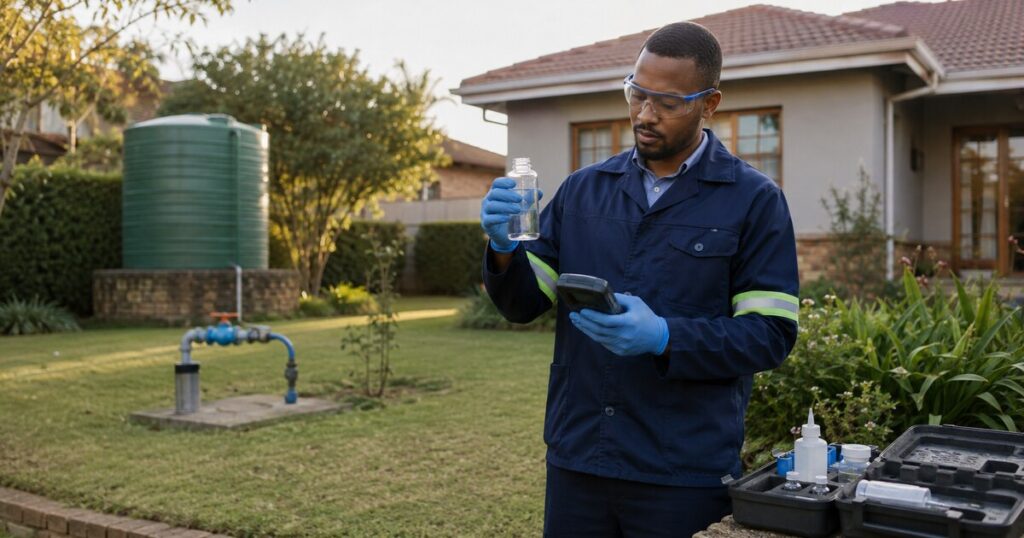
Borehole water testing South Africa homeowners can rely on begins before a bottle reaches the laboratory. You need to define how the water will be used, choose the right tests, collect a representative sample, keep it under the conditions specified by the laboratory and interpret the report against the correct standard. Missing any of those steps can produce a neat-looking certificate that does not answer the question you actually have.
This guide takes you through the complete process, from requesting a quotation to deciding what to do after the results arrive. It is written for private residential boreholes, including garden-only systems, homes that use borehole water for washing and toilets, and households considering drinking or cooking with it.
Borehole water testing South Africa: the quick answer
For water that may be consumed, ask a competent water-testing laboratory for a drinking-water assessment appropriate to a private borehole and the current South African drinking-water requirements. Tell the laboratory where the property is, how the water will be used, whether treatment is installed and whether there are local risks such as septic systems, agriculture, mining, industry or flooding.
The laboratory should confirm the required bottles, preservatives, sampling procedure, delivery temperature and holding times. For the most defensible result, use its trained sampler or follow its written instructions exactly. Test raw water to understand the source and test the final drinking tap to verify what people actually consume after tanks, filters and plumbing.
A test result is a snapshot of the sampled water under the conditions recorded on that day. It does not certify the borehole forever. Groundwater, storage tanks, treatment equipment and plumbing can all change, which is why a sensible testing programme includes baseline testing, verification after treatment and risk-based retesting.
If your first question is whether the supply can be consumed at all, read the companion explanation of whether borehole water is safe to drink in South Africa. This guide focuses on how to obtain and use reliable test evidence.
What a borehole water test can—and cannot—prove
A laboratory analysis can show whether the submitted sample met selected limits or guidance values for the parameters tested. It can identify problems that sight, smell and taste cannot detect. Depending on the panel, this may include microbial contamination, nitrate, fluoride, dissolved salts, metals and operational characteristics such as hardness or pH.
Testing can help answer four different questions:
- Source quality: What is coming from the borehole before storage or treatment?
- System quality: Is a tank, filter, pipe or household fitting changing the water?
- Treatment performance: Does the treated water at the point of use meet the intended target?
- Change over time: Has quality shifted since the baseline or previous test?
A single test cannot prove that every litre supplied in future will be safe. It also cannot explain the cause of every failure without additional evidence. If one tap fails while the borehole outlet passes, the problem may be in the tank or plumbing. If both fail, the source or borehole protection may be involved. If a result is unexpected, a carefully planned confirmation sample is usually more useful than guessing.
Clear water is not a laboratory result
Clarity is an aesthetic observation, not proof of safety. Bacteria and several dissolved chemicals can be present without changing the appearance of the water. Equally, reddish staining caused by iron or hard-water scale can be inconvenient without necessarily being the most important health risk. A proper analysis separates health, aesthetic and operational concerns instead of treating every visible problem as equally dangerous.
The Department of Water and Sanitation’s South African Water Quality Guidelines for domestic use explain that water quality must be judged in relation to its intended use. For drinking-water decisions, ask the laboratory to use the current applicable South African requirements rather than relying on a generic online chart.
Choose the test panel for the intended use
The phrase “test my water” is too vague for a useful quotation. A garden-irrigation assessment, a basic microbial screen and a comprehensive drinking-water assessment are different services. The correct panel depends on what the water will touch, who may be exposed and which contaminants are plausible at the property.
| Intended use | Questions the panel should answer | What to tell the laboratory |
|---|---|---|
| Garden irrigation | Could salinity, sodium, pH, specific ions or other characteristics harm soil, plants or irrigation equipment? | Plant types, irrigation method, soil concerns, staining, blockage or leaf damage. |
| Toilets and outdoor cleaning | Are there microbial, odour, staining, sediment or scaling issues that affect safe handling and equipment? | Likelihood of aerosols, children accessing the water, tanks and hose points. |
| Laundry and bathing | Could water quality affect skin exposure, fixtures, fabrics, geysers or household plumbing? | All indoor uses, vulnerable occupants, colour, odour, hardness and corrosion signs. |
| Drinking and cooking | Does the water comply with the appropriate drinking-water requirements for the full required set of determinants? | Private borehole, source location, raw or treated sample, household use and risk factors. |
| Livestock | Is the water suitable for the species and production system? | Animal species, age, feed, production purpose and expected daily consumption. |
For a new drinking-water source, do not quietly downgrade a comprehensive assessment to the cheapest small panel without understanding what is excluded. A basic microbial result can be valuable, but it says nothing about untested chemicals. A chemistry panel does not rule out microbial contamination. Ask for the parameter list in writing and ask the laboratory what important risks remain outside it.
When a standard panel may need additions
Site history should influence the scope. Nearby septic tanks or pit latrines increase concern about faecal contamination and nitrate. Intensive farming may justify discussion of nutrients or pesticides. Mining and industrial activity may introduce site-specific metals or chemicals. Coastal geology can affect salinity. Old plumbing may add metals after water leaves the borehole. A flood can wash contaminants into poorly sealed headworks.
These are reasons to speak to the laboratory or a groundwater specialist, not reasons to order every test available. Good testing is risk-led: broad enough to protect the intended use, but targeted enough that the results can guide action.
How to choose a water-testing laboratory
Use a laboratory that can demonstrate competence for the specific water tests you need. In South Africa, the South African National Accreditation System (SANAS) provides a database of accredited conformity-assessment bodies and their scopes. Accreditation is not merely a badge on a website: the relevant question is whether the laboratory’s current scope covers the particular methods or determinants in your order.
Before paying, ask the laboratory:
- Do you test private borehole water for the intended use I described?
- Which exact parameters are included and which are excluded?
- Are these tests covered by your current accreditation scope?
- Will the report compare results with the current applicable drinking-water standard or another stated guideline?
- Do you supply the correct sterile and preserved bottles?
- Do you provide a trained sampler, and is sampling included in the quoted price?
- What are the collection, cooling and delivery instructions?
- What is the normal reporting time, and will urgent microbial findings be communicated early?
- Can a technical person explain non-compliant, borderline or unusual results?
A professional report should identify the sample, sampling location and date; list the test method and result for each determinant; show units and reporting limits; state the comparison criteria where applicable; and clearly identify any qualifications. If the laboratory did not collect the sample, the report may note that sampling falls outside its responsibility. That distinction matters.
Build a sampling plan before opening a bottle
A useful plan begins with the question you want the result to answer. Randomly choosing the easiest tap can blur source, storage and treatment effects.
| Sampling point | Question answered | Typical value |
|---|---|---|
| Dedicated raw-water point before tank and treatment | What does the borehole itself produce? | Baseline quality and treatment design. |
| Tank outlet | Is storage changing the water? | Investigating contamination, sediment or poor tank hygiene. |
| After each treatment stage | Which component is or is not working? | Commissioning and troubleshooting. |
| Kitchen drinking tap | What are occupants actually consuming? | Final drinking-water verification. |
| Problem tap | Is a local fixture or pipe run responsible? | Investigating taste, odour, colour or staining at one location. |
For a new whole-house drinking system, paired raw and final-tap samples are often more informative than one bottle. The raw result guides treatment; the final-tap result verifies the entire system. If money is limited, explain that constraint to the laboratory and ask which sequence gives the safest decision, rather than choosing a sample point by convenience.
Record recent events that may affect interpretation: heavy rain, flooding, borehole rehabilitation, shock disinfection, pump replacement, empty tanks, filter changes, long periods of non-use or unusual pumping. A report without context is harder to diagnose.

How to collect a borehole-water sample correctly
The laboratory’s instructions take priority because different analyses require different containers, preservatives and handling. Microbiology bottles are normally sterile and may contain a substance needed for the method. Chemistry bottles may be prepared differently. Never transfer water into a household jar, rinse a laboratory bottle unless instructed, or pour samples between containers.
- Arrange bottles before sampling. Confirm the number and type of containers, collection date, laboratory receiving hours and maximum delivery time.
- Choose the point identified in the plan. Avoid a leaking, dirty or rarely used fitting unless that fitting is the subject of the investigation.
- Remove attachments if instructed. Hoses, aerators, filters or swivel fittings can retain contamination. Follow the laboratory’s procedure for the test.
- Clean or disinfect the outlet only as directed. Do not improvise with chemicals that could contaminate the sample or create a misleading result.
- Flush for the specified period or until field readings stabilise. The aim is to collect the target water, not water that has stood in a short pipe. The correct approach depends on the sampling point and objective.
- Keep the bottle clean. Do not touch the inside of the cap, bottle neck or container. Keep the cap in your hand with its clean side protected.
- Fill as instructed. Some bottles need headspace; others do not. Do not guess.
- Close immediately. Ensure the cap is secure without contaminating it.
- Identify the sample. Use the laboratory’s label or chain-of-custody form. Record the exact point, raw or treated status, date, time and collector.
- Cool and transport as instructed. Put the bottles into the supplied or recommended cooler arrangement promptly.
Field measurements such as temperature, pH or electrical conductivity may be useful because some characteristics can change after collection. A laboratory or professional sampler will advise whether these readings belong in the plan. A cheap handheld total-dissolved-solids meter can help track trends, but it cannot replace microbiological and chemical analysis.
Should you pump before sampling?
If the objective is aquifer or raw-borehole quality, stagnant water in the rising main or surface pipework may not be representative. The system may need to run before sampling. The correct purge is not a universal “five-minute rule”: it depends on the borehole, pump, sampling point, recent use and what the test is intended to represent. Follow the sampling plan supplied by the laboratory or groundwater professional.
Preservation, chain of custody and delivery
A carefully collected sample can still become unusable if it is left in a hot vehicle or delivered after the method’s holding time. Microbiological samples are particularly time-sensitive. Book the test so the laboratory is open when you collect; do not take a sample on a Friday afternoon and assume it will remain valid until Monday.
Use the cooling method specified by the laboratory. Keep bottles protected from direct sunlight, upright and separated from loose ice or contaminated items where instructed. Do not freeze a sample unless the laboratory specifically requires it.
The chain-of-custody record should connect the bottle to the result. It normally captures the client, site, sample point, date and time, collector, requested analyses and handover details. If there is a dispute or a surprising result, this record helps establish what was actually tested.
South African groundwater investigations commonly refer to the SANS 5667 series for sampling, preservation and handling. Homeowners do not need to memorise the standard. They do need to use a laboratory whose containers and instructions match the requested methods.

How to read a borehole-water laboratory report
Start by checking the sample details before looking at the pass/fail column. Is it your property? Is the sample point correct? Was it raw or treated water? Are the collection and receipt dates plausible? If those facts are wrong, contact the laboratory before making decisions.
Then read each result across the row:
- Determinant or parameter: what was measured.
- Result: the amount found, or a statement that it was below the method’s reporting limit.
- Unit: essential for comparison; milligrams per litre and micrograms per litre are not interchangeable.
- Method: how the laboratory performed the analysis.
- Limit or target: the reference used for the intended use.
- Compliance or comment: the laboratory’s classification, where supplied.
“Not detected” does not mean absolute zero. It usually means the concentration was below the method’s stated detection or reporting capability. “Complies” means the tested sample met the cited criteria for the tested determinants; it does not cover parameters that were not ordered.
What SANS 241 means in practice
SANS 241 is the central South African reference for drinking-water quality. The standard distinguishes risks that may have acute health significance, chronic health significance, aesthetic effects and operational consequences. The exact edition, determinant set and assessment rules matter, so use the laboratory’s current interpretation rather than copying limits from an old article or report.
The Department of Water and Sanitation’s drinking-water quality compliance information illustrates how results are grouped and assessed in regulatory monitoring. Municipal monitoring and a homeowner’s private sample are not the same programme, but the principle is useful: quality management depends on repeated, risk-based evidence, not one visual inspection.
Common borehole-water parameters explained
| Parameter group | What it may indicate | Why it matters |
|---|---|---|
| E. coli and coliform indicators | Possible faecal contamination, system hygiene problems or pathways from the surface. | Microbial failures can require immediate protective action and investigation. |
| Turbidity | Suspended particles, sediment or treatment performance. | Cloudiness can interfere with disinfection and may signal a physical problem. |
| pH | How acidic or alkaline the water is. | Can affect corrosion, taste and treatment performance. |
| Electrical conductivity and dissolved salts | Overall ionic or mineral content. | Useful for salinity, taste, irrigation and trend monitoring, but not a complete safety test. |
| Hardness, calcium and magnesium | Scale-forming potential. | Affects geysers, appliances, soap use and treatment selection. |
| Iron and manganese | Natural geology, corrosion or changing source conditions. | Can cause staining, deposits, taste and filter blockage. |
| Nitrate and nitrite | Natural processes, sanitation, fertiliser or other land-use influences. | Health relevance can be especially important for infants and vulnerable users. |
| Fluoride | Natural interaction with local geology. | Long-term intake matters; appearance and taste are not reliable screens. |
| Chloride, sodium and sulphate | Geology, salinity or local contamination pathways. | May affect taste, corrosion, irrigation and treatment requirements. |
| Metals and site-specific organics | Geology, plumbing, mining, industry, fuels or agricultural activity. | Testing should be guided by site risk and professional advice. |
This table is a guide to questions, not a substitute for the report. Two parameters can interact operationally, and the correct remedy depends on concentrations, flow rate, water demand and the rest of the chemistry.
What to do after the results arrive
Sort findings into three decision groups: immediate health protection, system or treatment action, and longer-term maintenance. Ask the laboratory to clarify any unfamiliar classification.
If all requested parameters comply
Confirm that the panel was broad enough for the intended use and that the sample came from the correct point. Keep the report as a baseline, record treatment settings and service dates, and set a retesting plan. A compliant raw sample does not remove the need to protect the borehole head, clean tanks and maintain plumbing.
If a microbiological result fails
Stop using the affected supply for consumption unless a competent authority advises otherwise. Use a known safe alternative, investigate the borehole seal, surface drainage, storage tank, plumbing and treatment system, and arrange corrective work. Disinfection may be part of the response, but it should not become a ritual that hides a continuing contamination pathway. Retest after the corrective process and before resuming drinking use.
If a chemical result fails
Do not assume boiling will help; boiling does not remove many dissolved chemicals and can concentrate some substances as water evaporates. Obtain contaminant-specific advice. Depending on the findings, the solution may involve changing the point of use, blending, adsorption, ion exchange, membrane treatment, pH correction or choosing a different source. Every option has limits, maintenance requirements and a waste stream.
If the issue is mainly aesthetic or operational
Staining, scale, sediment, taste and corrosion still deserve attention because they affect pipes, geysers, pumps and treatment performance. Use the result to design a proportionate solution. A sediment cartridge will not solve dissolved salts; a softener will not disinfect water; ultraviolet disinfection will not remove iron or nitrate. Treatment must match the actual failure.
After treatment is installed, test at the final point of use. This verification step is the only practical way to show that the chosen system, in its real configuration, is producing the intended water quality.

How often should borehole water be tested?
There is no single schedule that suits every private borehole and every determinant. A practical programme is based on use, vulnerability, previous results and change. Drinking supplies deserve more rigorous monitoring than garden-only supplies. A shallow or poorly protected source near sanitation or agriculture deserves more attention than a well-protected source with a stable history.
Consider testing:
- before first using a new borehole for any household purpose;
- before drinking or cooking with it;
- after installing, changing or repairing treatment equipment;
- after borehole rehabilitation, pump work, tank cleaning or plumbing changes;
- after flooding, major runoff, contamination incidents or a damaged borehole cap;
- when colour, odour, taste, sediment or staining changes;
- when unexplained gastrointestinal illness affects users;
- when neighbouring land use changes; and
- at a routine interval agreed with the laboratory or environmental health professional.
Your regular borehole maintenance checklist should include water-quality records, tank hygiene and treatment consumables. Testing works best as part of system care rather than as an isolated emergency purchase.
What borehole-water testing costs and how long it takes
There is no dependable national flat price. Cost changes with the number and complexity of parameters, whether sampling and travel are included, whether the tests fall within an accredited scope, the number of sample points and how urgently results are needed. A basic screen and a broad drinking-water assessment should not be compared as if they were the same product.
Ask for an itemised written quotation showing:
- sample collection and travel;
- bottles, preservatives and courier arrangements;
- the exact microbiology and chemistry parameters;
- interpretation or consultation;
- taxes and any urgent-service fee; and
- the expected reporting date.
Turnaround also varies by method. Some microbial work can produce earlier indications while specialised chemistry may take longer. Plan around the laboratory’s promised date and keep using a known safe source until drinking suitability is confirmed. Testing and treatment belong in the full ownership budget described in the guide to borehole versus municipal water costs.
Common borehole-water testing mistakes
- Buying the cheapest panel without checking exclusions. The result may not address the intended use.
- Using a food jar or rinsed soft-drink bottle. Household containers can contaminate a sample or lack the required preservative.
- Sampling from a hosepipe. The hose may add microbes, plastic-related compounds or stagnant water.
- Touching the bottle neck or cap interior. Small handling errors can undermine microbiological results.
- Taking a treated sample when designing treatment. A raw sample is normally needed to understand what must be removed.
- Taking only a raw sample when verifying drinking water. The kitchen tap captures effects from treatment, tanks and plumbing.
- Leaving the sample warm or delivering it late. The laboratory may reject it or qualify the result.
- Reading “clear” as “safe”. Important hazards can be invisible.
- Buying a generic filter before testing. No single device solves every microbial, mineral and chemical problem.
- Failing to retest after corrective work. Installation is not proof that treatment works.
Borehole water testing checklist for homeowners
- Write down the intended uses and who will be exposed.
- List nearby contamination risks and recent changes.
- Select a laboratory and verify its relevant scope.
- Obtain the exact panel, exclusions, price and turnaround in writing.
- Decide whether raw, tank, treated-tap or paired samples are needed.
- Collect only in the supplied containers and follow instructions exactly.
- Record sample points, date, time and system conditions.
- Deliver within the required holding time and temperature conditions.
- Check sample details, units, methods and comparison criteria on the report.
- Use a safe alternative source while a health-related failure is unresolved.
- Choose treatment only from the complete evidence.
- Retest after treatment or repairs and keep reports together.
If this is part of a new installation, the complete South African homeowner’s borehole guide will help you place quality testing alongside drilling, yield, pumps, storage, legal checks and maintenance. Municipal requirements can also affect private systems. For example, the City of Cape Town’s alternative-water system process requires careful separation from the municipal network and may request water-quality information for internal systems. Always check the rules for your own municipality.
Frequently asked questions
Can I test borehole water with a home kit?
Home kits and meters can be useful for selected screening or trend checks, but they do not replace a competent laboratory assessment for drinking-water decisions. A TDS meter, for example, cannot detect E. coli, nitrate, fluoride or every metal.
Does boiling borehole water make it safe?
Boiling can inactivate many microorganisms when done correctly, but it does not remove many dissolved chemicals, salts or metals. It may concentrate some dissolved substances. Use the test results to identify the actual problem.
Can I collect the sample in my own bottle?
Not unless the laboratory explicitly approves it. Use the containers it supplies. Sterility, bottle material, preservatives, headspace and cleanliness can all affect results.
Should I sample at the borehole or kitchen tap?
It depends on the question. Sample before treatment to characterise the source; sample the drinking tap to verify what people consume. Paired samples are often best for designing and verifying a treatment system.
Should I test after heavy rain?
Heavy rain or flooding can change contamination risk, particularly where headworks, casing seals, drainage or nearby sanitation are poor. If conditions changed materially, discuss targeted retesting with the laboratory.
What should I do if the water fails?
For a health-related failure, stop using the affected water for consumption and use a known safe source. Confirm the finding where advised, investigate the cause, correct the source or system problem, and retest before resuming use.
Which filter should I buy?
Choose treatment after the laboratory results are interpreted. Sediment filters, activated carbon, softeners, iron-removal media, ultraviolet systems and reverse osmosis solve different problems and have different maintenance needs.
How do I know if a laboratory is suitable?
Ask whether it routinely tests private borehole water, request its relevant current accreditation scope, confirm the parameter list and ensure it can give correct sampling and delivery instructions.
How long is a borehole-water certificate valid?
A report describes the sample taken at a specific place and time. It is not a permanent certificate for the source. Retesting should be based on intended use, previous results, local risk and system changes.
Conclusion
Borehole water testing South Africa homeowners can trust is a chain of evidence: the right question, the right panel, a representative sample, correct handling, competent analysis and a decision that matches the results. The laboratory certificate is only as useful as the plan behind it.
Begin by telling the laboratory exactly how you intend to use the water. Use its bottles and instructions, sample the raw source and final tap where appropriate, and keep the sample cool and on time. When the report arrives, check the details and units before acting. Treat the actual problem, verify the treated water and keep testing as part of ongoing borehole care.
That measured approach protects health, prevents unnecessary equipment purchases and gives you a reliable baseline for managing the borehole over time.
