Boreholes in South Africa can give homeowners a valuable supplementary water source, but a successful system involves far more than drilling until water appears. The best results come from matching the borehole to the property’s geology, water demand, legal obligations, sustainable yield, pump requirements and water quality.
This complete homeowner’s guide explains the full journey: deciding whether a borehole makes sense, choosing a drilling point, understanding a quotation, managing the drilling process, testing yield and water quality, selecting pumps and storage, and looking after the system once it is running.
Quick answer: what should a homeowner know first?
A residential borehole is not a guaranteed underground tap. It is a site-specific groundwater project. A geophysical survey can improve siting decisions but cannot guarantee success; drilling establishes what is actually underground; a scientific yield test shows how much water can be abstracted sustainably; and laboratory testing determines whether treatment is needed for the intended use.
Before spending money, define how much water you need, check national and municipal rules, insist on a detailed written quote, and budget for the complete system—not only the drilled hole.
What a residential borehole system actually is
A borehole is a narrow, engineered hole drilled into the ground to intersect water-bearing geological formations. That groundwater occupies pores, weathered zones, fractures and joints below the surface. The borehole provides access to it; a pump and the rest of the system bring it to where it is needed.
In much of South Africa, groundwater is found in weathered and fractured rock rather than in a single large underground lake. Two neighbouring properties can therefore obtain very different results. One borehole may intersect several productive fractures while another, only a short distance away, may encounter weak inflow or no economical supply.
This is why regional maps, nearby boreholes and local experience are useful context but not guarantees. The Department of Water and Sanitation’s hydrogeological maps show groundwater occurrence and typical borehole yields at regional scale, but the Department specifically warns that these maps are not suitable for site-specific borehole siting.
A complete residential borehole system may include:
- the drilled hole, casing, sanitary protection and secure cap;
- a submersible pump, rising main and electrical cable;
- dry-run, overload and surge protection;
- a storage tank and level controls;
- a booster pump or pressure vessel;
- filters or treatment selected from laboratory results;
- pipework to irrigation or approved household points; and
- meters or monitoring equipment where required or useful.
If you want to understand the geology before looking at equipment, read how boreholes find water underground in South Africa.
Is a borehole right for your property?
Boreholes in South Africa are used for gardens, toilet flushing, cleaning, livestock, backup supply and, after suitable testing and treatment, some indoor applications. The right design depends on your intended use. A garden-only system is very different from a system expected to supply several bathrooms every day.
Start with a practical feasibility check rather than the assumption that every home needs the same setup.
| Question | Why it matters | What to establish |
|---|---|---|
| What will the water be used for? | Use determines required quality, treatment, storage and legal checks. | Garden only, toilets and laundry, whole-home backup, drinking, livestock or another use. |
| How much water is needed? | The pump and sustainable abstraction rate must match realistic daily demand. | Daily litres, peak flow and seasonal irrigation demand. |
| Can a rig reach the drilling point? | Large equipment needs safe access, turning space and overhead clearance. | Gate width, surfaces, walls, trees, cables and neighbouring structures. |
| What contamination risks exist? | Poor siting or completion can expose groundwater to pollutants. | Septic systems, drains, fuel, chemicals, waste areas and flood-prone ground. |
| What does the municipality require? | Local bylaws may require notice, application, registration, signage or restrictions. | Written requirements for your exact property and intended use. |
| Can you fund the full system? | A drilled hole without testing, a correctly selected pump and usable delivery system is incomplete. | Survey, drilling, casing, testing, pump, electrical work, tank, treatment and reinstatement. |
A borehole is usually most compelling where water demand is meaningful, municipal supply is unreliable or expensive, groundwater prospects are reasonable, and the owner is willing to manage the source responsibly. It is less attractive when access is poor, the intended use is very small, local groundwater quality is difficult, or the project budget covers drilling only.
The complete borehole process for South African homeowners
1. Define the intended use and water demand
Write down every intended use before requesting quotes. Estimate average daily demand and the busiest hour. Irrigation can dominate household demand, especially in hot months, so separate indoor and outdoor requirements.
This calculation does not need to be perfect, but it must be realistic. It gives the geohydrologist and system designer a target and prevents the installer from selecting equipment using guesswork.
2. Check legal and municipal requirements
Do this before drilling, not after the rig arrives. National water law distinguishes reasonable Schedule 1 domestic use from larger or commercial water uses, while municipal bylaws may add local notice or registration requirements. Ask the municipality for the current written rule that applies to your property.
3. Assess the property and select a drilling point
A professional site assessment considers geology, topography, nearby borehole information, possible contamination sources, access and the route that pipes and cables will take. A geophysical survey may identify geological contrasts or fracture zones that deserve investigation.
Survey results improve the quality of the siting decision, but they do not prove that a particular yield or water quality will be obtained. Be cautious of anyone who guarantees a specific water strike before drilling.
4. Obtain comparable written quotations
Ask at least two or three suitable contractors to quote against the same scope. A cheap rate per metre can become expensive if mobilisation, casing, difficult geology, testing, disposal, tax or minimum charges are excluded.
The quote should clearly state who carries the dry-hole and extra-depth risk, what happens when geological conditions change, and what evidence you will receive when work is complete.
5. Drill, log and construct the borehole
The drilling method is chosen for the local formation and project. As work proceeds, the driller should record depth, formations, water strikes, casing and completion details. Proper construction protects the hole against collapse and helps reduce pathways for surface contamination.
Drilling may continue beyond the first water strike to investigate deeper fractures or achieve the planned construction depth. A visible rush of water during drilling is encouraging, but it is not a substitute for a controlled yield test.
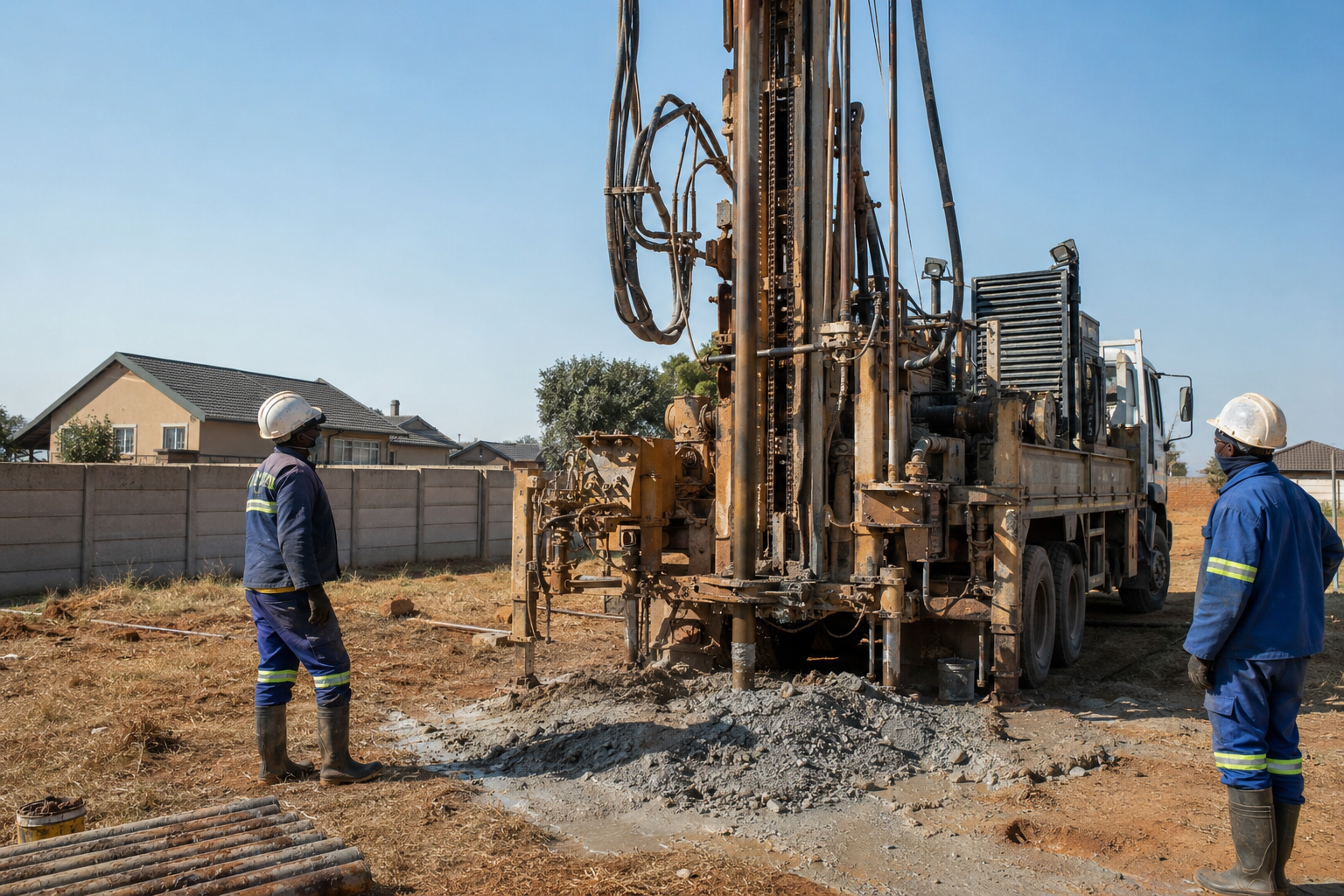
For a detailed view of rigs, casing, borehole development and completion, see our step-by-step explanation of how borehole drilling works.
6. Develop the borehole and test its performance
Borehole development removes drilling debris and fine material and helps establish a cleaner hydraulic connection with the formation. The completed borehole should then be assessed under pumping conditions.
A proper test records more than litres per hour. It can show the static water level before pumping, the drawdown while pumping, the dynamic water level, the recovery after pumping and the behaviour of the borehole at a controlled rate. These measurements help a competent professional recommend a sustainable abstraction rate and pump position.
The Department of Water and Sanitation’s groundwater guidance advises that an abstraction rate and duty cycle should be calculated and recommended. That rate is far more useful than selecting a pump simply because it can move a large volume of water.
7. Take a representative water sample
Have the water tested by a reputable laboratory, especially if it will be used indoors, around food, for drinking or where vulnerable people may be exposed. Ask the laboratory which bottle, preservation method and sampling procedure it requires. A poor sample can produce misleading results even when the laboratory analysis is accurate.
8. Design the pump, storage, pressure and treatment system
Pump selection should use the tested yield, pumping water level, installation depth, elevation difference, pipe friction, required pressure and household demand. Bigger is not automatically better. An oversized pump can draw the water level down too quickly, cycle inefficiently and shorten equipment life.
Storage separates borehole production from short periods of high demand. The borehole can fill a tank at a sustainable rate while a booster pump supplies taps or irrigation at the pressure users expect. Treatment must follow the water analysis rather than a generic filter package.
9. Commission the system and keep the records
Before handover, confirm flow, pressure, tank controls, dry-run protection, electrical protection, leaks and water routing. Keep the drilling log, construction record, yield-test report, laboratory results, pump data, warranties, photos, municipal correspondence and electrical compliance documents together.
Those records make future servicing, property transfer and fault-finding much easier.
How to budget for boreholes in South Africa
The cost of boreholes in South Africa varies too widely for one national price to be reliable. Geology, depth, casing, access, mobilisation, pump duty, electrical distance, storage and treatment all change the total.
As a broad 2026 planning range, many complete residential installations fall around R60,000 to R150,000 or more. This is not a quote and simpler or more complex projects can fall outside it. For updated component ranges, use our detailed guide to borehole costs in South Africa.
| Budget item | Questions to ask |
|---|---|
| Assessment and siting | Is a site visit or geophysical survey included? What deliverable will be supplied? |
| Mobilisation | Are transport, rig setup, site access and remobilisation included? |
| Drilling | What is the rate per metre, minimum charge and planned maximum depth? |
| Casing and completion | Which material, diameter, quantity, seal and borehole cap are included? |
| Development and testing | Is development included? What type and duration of yield test will be performed? |
| Pump equipment | Which pump model, cable, rising main, controller and protections are included? |
| Storage and pressure | What tank capacity, level control, booster pump and pressure arrangement are allowed for? |
| Water treatment | Is treatment provisional until laboratory results are known? |
| Electrical and plumbing | Who performs the work, and are compliance documents and municipal separation included? |
| Site reinstatement | Who repairs paving, garden areas, trenches, walls or access damage? |
Also build a contingency into the budget. Extra casing, deeper drilling, hard formations, long trenches, treatment and upgrades to pressure or electrical systems are among the borehole costs homeowners often overlook.
Components of a reliable home borehole system
A home borehole system works as a chain. If one component is badly sized or poorly installed, the whole system can become unreliable.
Borehole construction and headworks
Casing supports unstable formations and helps protect the borehole. The top should be securely capped and completed to discourage surface water, insects and debris from entering. The surrounding area should drain away from the borehole rather than forming a contaminated puddle around it.
Submersible pump and rising main
The pump must operate within the borehole’s sustainable performance and the manufacturer’s duty range. Its installation depth should reflect the pumping water level and borehole construction—not merely the total depth.
Electrical controls and protection
Useful protections may include overload, phase or voltage protection, dry-run protection, surge protection and level controls. Electrical work should be completed by an appropriately qualified person and protected against weather, moisture and accidental contact.
Storage, booster pump and pressure vessel
A tank creates a buffer between groundwater abstraction and household demand. A booster pump or pressure system then supplies the property. This design can reduce rapid cycling and allows a lower-yield borehole to serve short peaks, provided daily demand remains within sustainable production.
Filters and treatment
Sediment filtration, iron or manganese removal, hardness treatment, activated carbon, disinfection and other processes solve different problems. Installing every filter is wasteful; installing the wrong treatment can be ineffective. Start with laboratory results and a clear end use.

When the pump is installed, its position, cable support, pipe joints and controls matter. Our guide to borehole pump installation in South Africa explains that stage in more detail.
Yield, household demand and storage
Yield is the rate at which a borehole can supply water under specified test conditions. Sustainable yield is the rate that can be used without repeatedly drawing the water level below a safe operating point or damaging long-term reliability.
Important measurements include:
- Static water level: the resting level before pumping.
- Dynamic water level: the level while the pump is operating.
- Drawdown: the difference between static and dynamic levels.
- Recovery: how the water level rises after pumping stops.
- Tested discharge: the controlled pumping rate used during the test.
A low-yield borehole is not automatically useless. If it recovers consistently, a correctly sized pump can fill adequate storage slowly and safely. Conversely, a high-capacity pump can damage reliability when it repeatedly extracts faster than the borehole can recover.
Do not compare boreholes only by the largest litres-per-hour figure printed on a quote. Ask how long the test ran, what drawdown occurred, how the borehole recovered and what daily operating schedule was recommended. Our guide to typical borehole yield in South Africa provides more context for interpreting these figures.
Water quality and safe household use
Clear water is not necessarily safe water. Groundwater quality varies with geology, land use, borehole construction and nearby contamination sources. It can change over time after heavy rain, flooding, repairs, changes in surrounding land use or prolonged inactivity.
If borehole water may be consumed, ask a SANAS-accredited laboratory for analysis suitable for drinking-water assessment against the applicable SANS 241 requirements. The Department of Water and Sanitation explains in its drinking-water quality guidance that SANS 241 covers microbiological and chemical quality and is used to determine whether supplied water is fit for human consumption.
A useful test programme may include, depending on the intended use and local risks:
- microbiological indicators such as E. coli and total coliforms;
- pH, electrical conductivity and total dissolved solids;
- iron and manganese, which can cause staining or operational problems;
- hardness and alkalinity, which affect scaling and treatment;
- nitrate or other parameters linked to sanitation and land-use risks; and
- additional metals, salts or chemicals recommended for the local geology and intended use.
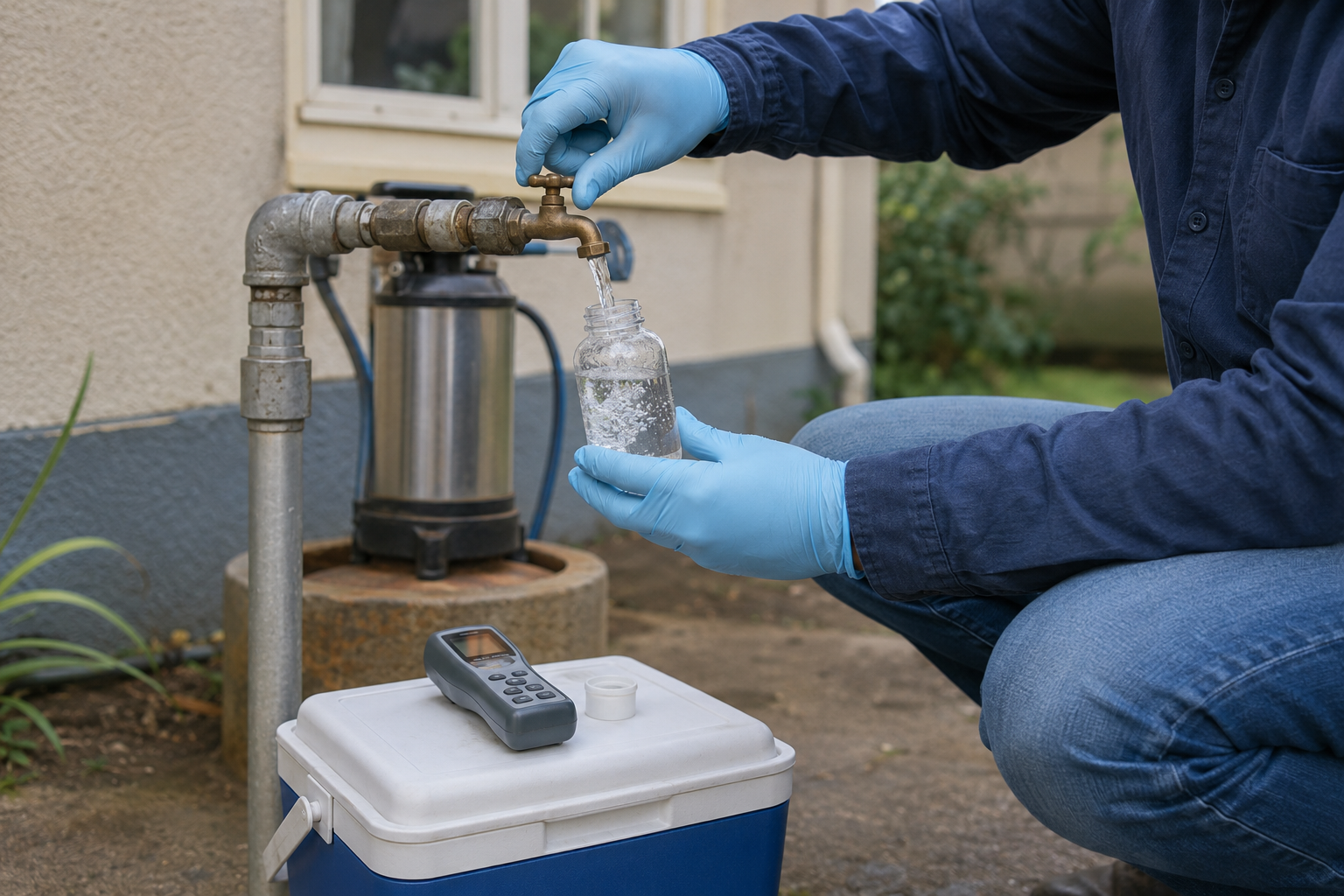
Do not buy a treatment package before knowing what needs treatment. A sediment cartridge will not remove dissolved salts, and a disinfection unit will not solve hardness or iron. The treatment train should be designed from the laboratory report, required flow and final use.
As a practical homeowner rule, test before first household use, after major repairs or contamination events, whenever taste, odour, colour or sediment changes, and periodically thereafter. Annual testing is a sensible baseline for water used in the home, but a laboratory or water-treatment professional may recommend more frequent testing for particular risks.
Laws, authorisation and municipal registration
Groundwater is regulated under the National Water Act 36 of 1998. Schedule 1 permits reasonable domestic use in a household and small, non-commercial gardening from a water resource to which the person has lawful access, subject to the Act. Schedule 1 also makes clear that this entitlement does not override another law, bylaw or regulation.
The Department’s groundwater FAQ explains an important distinction: nationally, one generally registers a water use rather than the physical hole. Schedule 1 use does not ordinarily require national water-use registration, but municipalities may require borehole registration or prior notice.
For example, the City of Cape Town requires homeowners to apply before sinking a new borehole or wellpoint and register it afterward. Rules differ by municipality, so Cape Town’s process should not be assumed to apply everywhere.
Uses beyond reasonable domestic Schedule 1 use—such as larger-scale irrigation, industrial abstraction, water bottling or selling groundwater—may fall under a General Authorisation or require a water-use licence and registration. The Department’s e-WULAAS authorisation guidance explains the main categories.
Because rules and restrictions can change, obtain current guidance for the property, catchment and intended use. Our dedicated article on borehole permits and registration in South Africa is a useful starting point, but it is not a substitute for written confirmation from the responsible authority.
Maintenance and long-term reliability
A well-constructed borehole can serve a property for many years, but pumps, filters, tanks, controls and valves need ongoing attention. Good maintenance is based on trends: a gradual fall in pressure, longer tank-filling time or rising sediment is easier to diagnose when you know what normal performance looks like.
Monthly homeowner checks
- Observe flow, pressure and tank refill time.
- Listen for rapid cycling, unusual starts or repeated trips.
- Inspect accessible pipes, valves and the borehole area for leaks or standing water.
- Check water appearance, odour and sediment.
- Record obvious changes instead of waiting for complete failure.
Periodic maintenance
- Clean or replace filters according to conditions and manufacturer guidance.
- Inspect tank lids, screens, overflows and internal cleanliness.
- Check pressure-vessel and control behaviour.
- Review pump protection and electrical condition.
- Retest water quality at an interval suitable for the use.
- Reassess yield and recovery if performance changes materially.
Do not assume that a loss of water means the aquifer is empty. Pump failure, electrical faults, blocked filters, leaks, incorrect control settings, sediment, declining yield and seasonal water-level changes can produce similar symptoms. Follow the structured BoreholeGuide maintenance checklist and investigate changes early.
Common mistakes to avoid
- Buying on price per metre alone. Compare the full scope, exclusions and risk allocation.
- Treating a survey as a water guarantee. It is a decision aid, not proof of yield or quality.
- Stopping at the first water strike without a clear technical reason. Construction decisions should follow the geology and project plan.
- Skipping a proper yield test. This leaves the pump designer without reliable operating data.
- Choosing the biggest available pump. Pump duty must match borehole performance and system head.
- Assuming clear water is drinkable. Laboratory testing comes before consumption or treatment design.
- Ignoring municipal rules. Schedule 1 does not cancel bylaws, registration or local restrictions.
- Connecting borehole and municipal systems carelessly. Poor cross-connection or backflow control can create health and compliance risks.
- Throwing away drilling and test records. These documents are essential for servicing and troubleshooting.
- Pumping without monitoring. Sustainable use requires attention to water levels, demand and changes over time.
What a good borehole quotation should tell you
Use this checklist when comparing proposals for residential boreholes in South Africa:
- contractor identity, experience, insurance and references;
- site assessment or survey scope and deliverable;
- mobilisation and access assumptions;
- drilling method, diameter and price per metre;
- minimum charge and maximum authorised depth;
- casing type, diameter, quantity and unit rate;
- sanitary completion and borehole cap;
- handling of drill cuttings, water and site damage;
- borehole development method;
- yield-test type, duration and report;
- water sampling and laboratory scope;
- pump make, model, duty point and installation depth;
- rising main, cable, safety rope and valves;
- dry-run, overload and surge protection;
- tank, level controls, booster and pressure equipment;
- treatment exclusions pending laboratory results;
- electrical and plumbing responsibilities;
- warranties, commissioning and handover records;
- tax and all exclusions; and
- payment stages linked to clear deliverables.
Ask contractors to explain vague items in writing. A proposal should let you compare like with like and understand what happens if the borehole is dry, deeper than expected or unsuitable for the intended use.
Frequently asked questions about boreholes in South Africa
Does a groundwater survey guarantee that a borehole will find water?
No. A competent assessment can improve the siting decision, but only drilling and subsequent testing reveal the actual conditions at that point.
How deep is a residential borehole in South Africa?
There is no standard depth. Useful water may be found at relatively shallow depth in one area and much deeper in another. Local geology and the construction needed to reach productive zones determine the final depth.
Can borehole water be used for drinking?
Potentially, but not on appearance alone. Have a representative sample analysed by a suitable accredited laboratory and install treatment only where the results and intended use require it.
Do homeowners need a borehole permit?
Reasonable domestic use may fall under Schedule 1 of the National Water Act, but municipal notice, application, registration, signage or restrictions may still apply. Larger, commercial or non-domestic uses can require registration or authorisation. Check both national and local requirements before work begins.
How much does a complete home borehole system cost?
A broad 2026 planning range is roughly R60,000 to R150,000 or more, but geology, depth, casing, pump duty, storage, treatment and access can move the total substantially. Obtain detailed property-specific quotations.
Does every borehole need a storage tank?
Not every system does, but storage is extremely useful where borehole production is slower than short peak demand. It can also make system operation gentler and provide a buffer during pump or power interruptions.
Can a borehole run dry?
Its performance can decline because of seasonal levels, drought, surrounding abstraction, over-pumping, clogging or physical deterioration. Sometimes the apparent “dry borehole” is actually a pump, electrical, filter or pipe problem.
How long does drilling take?
The drilling itself may take a day or several days, but the complete project includes assessment, access preparation, construction, development, yield testing, laboratory testing and equipment installation. Plan for the whole process rather than the rig time alone.
How long does a borehole last?
A properly designed, constructed and maintained borehole can remain useful for decades. Pumps, filters, controls and pressure equipment generally require servicing or replacement sooner than the drilled structure.
Will a borehole eliminate the municipal water bill?
Not necessarily. Savings depend on how the water is used, local tariffs, electricity, maintenance, treatment and whether municipal sanitation or other charges remain. Many homeowners use a borehole as a supplement rather than a complete replacement.
What documents should the homeowner receive?
Keep the drilling and geological log, construction record, yield-test report, water analysis, pump specifications, installation depth, equipment manuals, warranties, municipal correspondence, electrical compliance records and commissioning information.
Final homeowner checklist
- Define the intended use and realistic daily demand.
- Check national, municipal and estate requirements.
- Assess access and contamination risks.
- Use competent professionals for siting, drilling, testing and system design.
- Compare complete written scopes, not only per-metre prices.
- Insist on construction records and a meaningful yield test.
- Size the pump from tested conditions and total system head.
- Use storage to balance sustainable supply and peak demand where appropriate.
- Test water before household use and design treatment from results.
- Protect the electrical, plumbing and borehole-head installation.
- Keep records and monitor performance over time.
Boreholes in South Africa can become dependable, long-term household assets when they are treated as engineered groundwater systems rather than one-off drilling jobs. The strongest projects combine careful siting, documented construction, scientific performance testing, suitable equipment, responsible abstraction and ongoing water-quality management.
Begin with a clear purpose and a complete budget. Then choose professionals who can explain their decisions, provide evidence and leave you with a system you understand. That approach gives a residential borehole its best chance of delivering safe, practical and sustainable value.