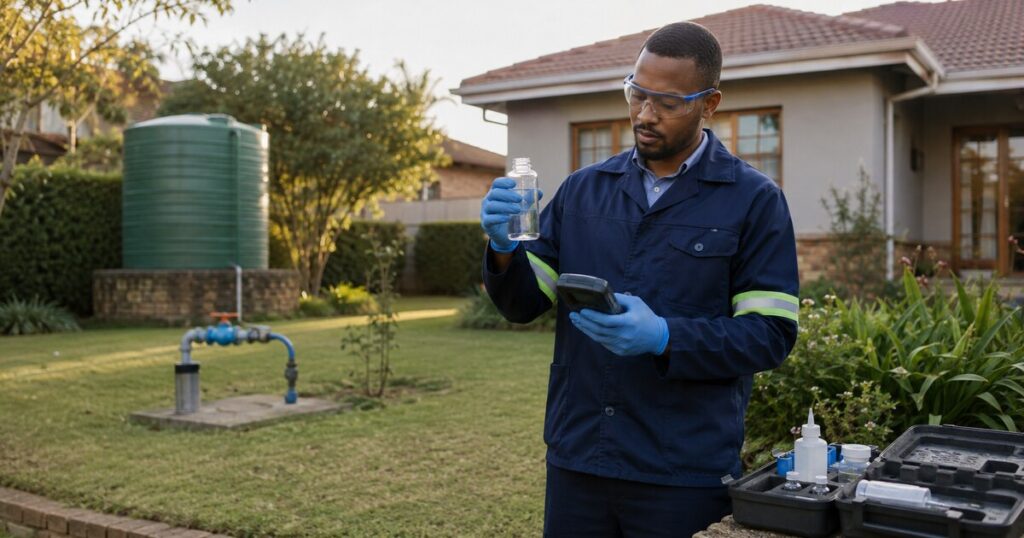
Is borehole water safe to drink? It can be, but only when a representative sample has been tested by a competent laboratory and the results show that the water is suitable for drinking. A clear glass, pleasant taste and lack of smell are encouraging, but none of them can rule out bacteria, nitrate, fluoride, dissolved salts or metals.
For a South African homeowner, the sensible approach is simple: test first, compare the results with the current drinking-water requirements, treat only the problems that were actually found, and verify the treated water before relying on it for drinking or cooking. This guide explains how to do that without buying unnecessary equipment or taking avoidable health risks.
Is borehole water safe to drink? The quick answer
Untreated borehole water should be regarded as an unverified private supply, not as automatically potable water. Groundwater often benefits from natural filtration as it moves through soil and rock, and many boreholes can supply good-quality water. The same journey can also dissolve naturally occurring minerals, while poor borehole protection, nearby sanitation, agriculture, flooding, leaking tanks or household plumbing can introduce contaminants.
The safe answer therefore belongs to your test report, not to a general rule about boreholes. The World Health Organization notes that drinking water can carry both microbial hazards and naturally occurring chemicals, including chemicals that are particularly relevant to groundwater. South African drinking-water assessment uses SANS 241 as the key reference for determining whether water is suitable for human consumption.
| Your situation | Practical decision |
|---|---|
| New borehole, no water-quality report | Do not assume it is safe. Arrange microbiological and chemical testing before drinking it. |
| Old report, but water now looks or tastes different | Use a known safe source and retest. A change can signal a source, tank, plumbing or treatment problem. |
| Report shows a failure | Do not select a generic filter. Ask the laboratory or a qualified treatment professional for a contaminant-specific solution. |
| Treatment has just been installed or serviced | Test water after the treatment point to confirm that the complete system is working. |
| Current report shows compliance at the drinking tap | The evidence supports drinking use for the sampled conditions. Keep the system maintained and retest when conditions or risks change. |
If you are new to private groundwater, start with the broader homeowner’s guide to boreholes in South Africa. It explains how the source, pump, storage and household delivery system fit together.
Why clear borehole water is not proof of safety
People naturally judge water with their senses. Cloudiness, a rotten-egg smell, salty taste, oily film or reddish staining clearly deserves investigation. The dangerous assumption is the reverse: that water without these signs must be safe.
Many important hazards are invisible at concentrations that matter. E. coli and other microbes do not need to make water cloudy. Nitrate may have no obvious taste or smell. Fluoride, arsenic and other dissolved substances cannot be assessed by looking at a glass. Even a basic handheld meter only measures selected characteristics; it does not perform a drinking-water assessment.
Appearance is still useful operational information. Orange or brown staining may point towards iron; black deposits may be associated with manganese; scale can indicate hardness; and a sudden rise in sediment may accompany a borehole, pump or aquifer change. These clues help decide what to investigate, but they do not replace laboratory analysis.
The source and the drinking tap are not the same sample
A borehole can produce acceptable water that is later contaminated in a storage tank, through an unsafe municipal-water cross-connection, or in poorly maintained household plumbing. The opposite can also happen: raw borehole water may fail one or more parameters, while a correctly designed and maintained treatment train produces compliant water at a dedicated drinking tap.
That distinction matters when you choose a sampling point. A raw-water sample tells you what the borehole produces. A sample at the kitchen tap tells you what the household consumes after tanks, filters and plumbing. For a new system, a laboratory or groundwater professional may recommend both.
Where borehole water risks come from
1. Natural geology
Groundwater is in contact with rock for long periods. Local geology affects pH, hardness and dissolved minerals, so two properties in the same province can produce very different water. Iron and manganese often create aesthetic or operational problems. Fluoride, nitrate, salinity and certain metals can become health or suitability concerns depending on concentration and exposure.
This is one reason a drilling success is not the same as a drinking-water success. A useful yield answers how much water the borehole can supply; water-quality testing answers what that water may safely be used for. Our guide to borehole yield in South Africa explains the quantity side of that distinction.
2. Surface contamination and poor construction
A borehole head that sits in a low point, has damaged sanitary protection or allows stormwater to pool around the casing is more vulnerable to surface ingress. Cracked aprons, unsealed cable entries and careless pipe penetrations can create pathways. Shallow or fractured aquifers may respond more quickly to events at the surface than a homeowner expects.
Nearby septic tanks, pit latrines, animal areas, fuel storage, fertiliser use and waste disposal are all relevant to the risk assessment. Distance alone is not a complete safeguard because groundwater direction, geology and borehole construction also matter.
3. Flooding, heavy rain and repairs
Floodwater can carry sewage, animal waste, fuel and agricultural chemicals. A borehole does not have to look physically damaged for its risk profile to change after inundation or intense runoff. International private-well guidance from the US Centers for Disease Control and Prevention specifically recommends testing after flooding and when colour, taste or smell changes. That is a sensible risk-based trigger for South African private boreholes too, even though local laboratory panels and municipal requirements must be followed.
Repairs can also disturb sediment or introduce microbes. After work on the pump, casing, tank or pipework, use the disinfection and commissioning process recommended by the responsible professional, flush where appropriate, and obtain a confirming sample before returning the water to drinking use.
4. Tanks, filters and household plumbing
Open or poorly sealed tanks admit dust, insects, small animals and sunlight. Sediment accumulates at the bottom. A filter cartridge left in service for too long can restrict flow or become a hygiene problem. An ultraviolet unit cannot work properly through turbid water, with a fouled sleeve, an expired lamp or an unsuitable flow rate. A reverse-osmosis membrane needs monitoring and maintenance.
A practical borehole maintenance checklist helps keep the whole chain—source, pump, tank, treatment and plumbing—in view.
What to test before drinking borehole water
Ask the laboratory for a drinking-water assessment suited to a private borehole, its location and its intended use. Do not order only a “basic mineral test” if the water will be used for drinking, and do not assume that a microbiology pass proves the chemistry is acceptable.
A useful first investigation commonly covers the following groups. The exact list should be confirmed with an accredited laboratory or qualified water professional because geology, nearby land uses and local history can justify additional parameters.
| Test group | Examples | Why it matters |
|---|---|---|
| Microbiological | E. coli, total coliform indicators and other tests advised by the laboratory | Looks for evidence of faecal contamination or poor system hygiene and helps assess acute illness risk. |
| General physical and chemical | pH, electrical conductivity or total dissolved solids, turbidity, colour, alkalinity and hardness | Describes overall water character, treatment needs, corrosivity or scaling tendency, and whether other tests may be affected. |
| Major ions and nutrients | Nitrate and nitrite, chloride, sulphate, sodium, calcium and magnesium | Identifies agricultural, sanitation, salinity, taste, scaling and health-related concerns depending on the result. |
| Metals and naturally occurring elements | Iron, manganese, fluoride and locally relevant trace elements | May affect health, taste, staining, appliances or treatment selection. Local geology determines priorities. |
| Site-specific contaminants | Pesticides, hydrocarbons or other substances selected from the property risk assessment | A standard package may not cover contaminants linked to a nearby spill, farm, workshop, landfill or industrial activity. |
A laboratory’s accreditation is not a blanket badge for every possible analysis. SANAS explains that accreditation demonstrates competence for a defined scope. Check that the laboratory’s current scope includes the water tests you require, and ask whether sampling must be performed by its own personnel. The South African National Accreditation System is the official place to verify accreditation information.

Should you test raw or treated water?
For a new drinking-water system, testing both can answer different questions:
- Raw borehole sample: establishes the source-water profile and gives the treatment designer a defensible basis.
- After storage but before treatment: can reveal whether tanks or distribution introduce a problem.
- At the drinking tap: verifies the water people actually consume.
If budget limits the number of samples, tell the laboratory exactly how the system is plumbed and what decision you need to make. It can advise on the most informative point and panel.
What SANS 241 means for a homeowner
SANS 241 is the South African drinking-water standard used to assess water intended for human consumption. It considers more than whether the water is visually acceptable: drinking-water quality involves microbiological, physical, aesthetic and chemical requirements, with risks considered over different time frames.
Municipal water providers operate monitoring programmes across their treatment and distribution systems. The City of Cape Town, for example, describes regular sampling of raw water, treated water, reservoirs and pipework against SANS 241 requirements on its water-quality page. A private homeowner does not automatically receive that continuing treatment, monitoring and operational oversight.
For a private borehole, “tested to SANS 241” should mean more than seeing the standard’s name on a quotation. Clarify:
- which parameters are included;
- whether the panel is a screening package or a complete assessment for the intended use;
- whether each method falls within the laboratory’s current accredited scope;
- where and how the sample will be collected;
- how quickly microbiological bottles must reach the laboratory;
- and whether the report includes an interpretation or only measured results.
Standards and municipal requirements can be updated. Ask the laboratory to use the current applicable drinking-water criteria on the date of analysis. Also check local rules for installing and using an alternative water supply. Municipalities may regulate registration, signage, backflow prevention and connections to municipal plumbing differently. The City of Cape Town’s alternative water-system guidance, for example, emphasises protecting the municipal system from cross-contamination; it should be treated as a Cape Town example, not a substitute for your municipality’s rules.
How to collect a useful borehole-water sample
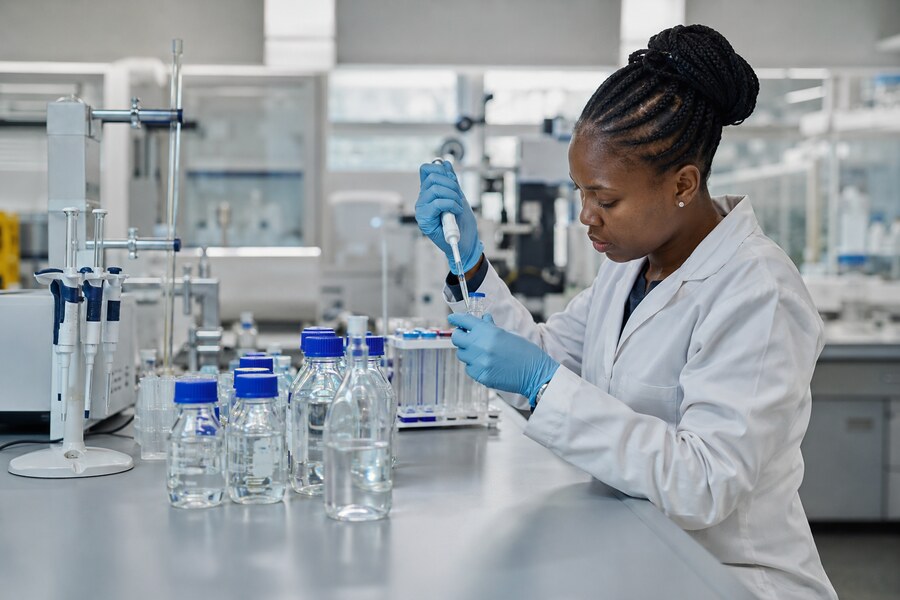
Bad sampling can make a good laboratory method answer the wrong question. Microbiology bottles may be sterile and contain preservatives. Some chemical tests require acidified bottles, cooling, protection from light or a short holding time. Always obtain the correct containers and written instructions from the laboratory before sampling.
- Agree on the purpose. Tell the laboratory whether you need raw-source characterisation, treatment design, post-treatment verification, or investigation of a complaint.
- Select the point. Use a clean, representative tap without a hose, aerator or leaking fitting where possible. Do not casually sample from an open tank or garden hose unless that exact location is the subject of the investigation.
- Prepare as instructed. The lab may require the outlet to be cleaned or disinfected and the water to run for a specified period. Groundwater investigations can require professional purging and field-parameter stabilisation.
- Protect the bottle. Do not rinse a sterile or preserved bottle unless instructed. Avoid touching the inside of the cap, bottle neck or tap with the container.
- Record the context. Note the date, time, sample point, whether treatment was operating, recent rain or repairs, unusual odour or colour, and any disinfectant use.
- Keep the sample correctly. Follow the laboratory’s temperature, packaging and transport requirements. Deliver it within the required holding time.
For high-stakes decisions, a laboratory or trained sampler should collect the sample. Current South African public procurement specifications for groundwater sampling reference formal groundwater sampling, preservation and handling standards, illustrating why representative collection is a technical task rather than simply filling any bottle.
How to read your laboratory report
A report usually lists each parameter, the measured value, its unit, the analytical method or detection limit, and a reference limit or assessment. Start by confirming that the sample description and point are correct. A kitchen-tap result cannot be interpreted as raw-source water if it passed through treatment.
Ask four questions
- Did any health-related parameter fail? Treat this as a stop-and-investigate result for drinking use, not as a taste issue.
- Did microbiology fail? Use a known safe supply while the contamination route, disinfection and system integrity are addressed. A single remedial action should be followed by verification.
- Are there aesthetic or operational failures? Iron, manganese, hardness, pH, turbidity or salinity can damage equipment or make water unpleasant even when the immediate health interpretation differs.
- Was the test scope adequate? “All tested parameters complied” only applies to the parameters actually tested. It does not rule out something omitted from the panel.
Units matter. A milligram per litre is one thousand times a microgram per litre. Do not compare a number to an online limit without checking the units, current standard edition and whether the value is a maximum, operational target or screening level. Ask the issuing laboratory to explain uncertain notation, results near a limit, or contradictory duplicates.
One test is a snapshot
A compliant result supports the quality of the sampled water at that time and place. It is not a lifetime certificate for the aquifer, borehole, tank and treatment system. Rainfall, pumping patterns, nearby land use, equipment failure and maintenance can change conditions.
Keep reports together with service records. Trends in conductivity, nitrate, iron, manganese or bacterial indicators can be more informative than disconnected once-off tests. Changes in water level or output can also accompany system changes; learn the warning signs in Can Boreholes Run Dry in South Africa?.
Choosing treatment from the laboratory results
The best treatment system is the smallest robust system that addresses the verified contaminants at the required flow rate. Buying a row of filter housings before testing often wastes money because different problems require different mechanisms.
| Finding | Possible treatment approach | Important limitation |
|---|---|---|
| Sediment or turbidity | Source correction where possible, settling or staged sediment filtration | Removing particles alone does not disinfect water or remove dissolved chemicals. |
| Microbiological contamination | Repair contamination pathways, clean tanks and pipework, then use a designed disinfection barrier such as UV or controlled chlorination | UV needs suitable clarity, dose and maintenance; chlorine needs correct dose and contact time. Neither corrects every chemical problem. |
| Iron or manganese | Oxidation and filtration, or another process selected from water chemistry | Ordinary sediment cartridges may clog rapidly and may not remove dissolved forms effectively. |
| Hardness | Ion-exchange softening where justified | Softening changes mineral balance and is not a general drinking-water purifier. |
| High dissolved salts, nitrate or selected ions | Properly designed membrane treatment such as reverse osmosis, or an alternative safe supply | Performance depends on membrane selection, pressure, pretreatment, recovery, waste stream and maintenance. Confirm removal with post-treatment testing. |
| Taste or odour compounds | Activated carbon or targeted oxidation, depending on the identified cause | Carbon does not reliably make microbiologically unsafe water safe and must be maintained hygienically. |
The CDC’s overview of home water treatment systems makes the same central point: test first, then choose equipment that is specifically capable of reducing the germ or chemical of concern. Treatment labels, flow ratings and consumable schedules matter.
Does boiling make borehole water safe?
Boiling is a useful emergency measure against many microbes when authorities advise it and the water is otherwise suitable for that response. It is not a complete borehole treatment plan. Boiling does not remove dissolved salts, nitrate, fluoride or metals, and evaporation can increase the concentration of non-volatile dissolved substances. If chemical contamination is suspected or confirmed, use another known safe supply until qualified advice addresses the specific problem.
Verify treatment instead of trusting the hardware
After commissioning, sample at the actual drinking point. A shiny installation does not prove the dose, contact time, membrane performance or plumbing arrangement is correct. Also check that untreated borehole water cannot cross-connect with municipal drinking water; follow local plumbing and municipal requirements.
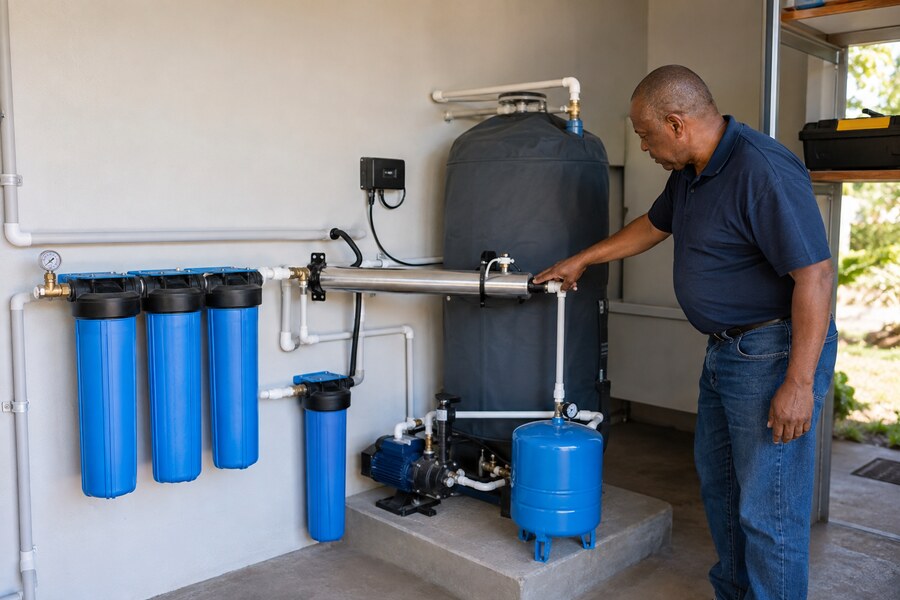
Build recurring maintenance into the budget. Lamps lose output, sleeves foul, media exhausts, cartridges clog and tanks need inspection. If you are comparing a private supply with municipal water, include testing and treatment in the full borehole-versus-municipal cost comparison.
How often should borehole water be tested?
There is no single interval that fits every private borehole and every parameter. A defensible schedule combines a periodic baseline with event-triggered testing. The laboratory, local environmental health service or groundwater professional can tailor it to the source, users and local hazards.
For a household drinking supply, an annual microbiological and basic water-quality review is a practical minimum starting point used in international private-well guidance, but higher-risk systems may need more frequent monitoring and broader chemistry may follow a different cycle. Do not treat “once a year” as a guarantee or as a universal South African legal rule.
Retest sooner when:
- the borehole is new or has returned to service after a long shutdown;
- floodwater reached the borehole area, or exceptional rain caused runoff around the head;
- the pump, casing, tank, treatment system or plumbing was repaired;
- taste, smell, colour, staining, sediment or clarity changes;
- neighbours using the same aquifer report contamination;
- a septic system fails or nearby land use changes;
- treatment alarms, flow readings or consumable life indicate a problem;
- someone in the household has unexplained gastrointestinal illness;
- or a previous result was close to a limit or showed a worsening trend.
Vulnerable users deserve a conservative approach. Infants, pregnant people, older adults and people with weakened immune systems may face greater consequences from certain microbial or chemical hazards. Discuss the report with a healthcare professional where a specific exposure or health concern exists.
Warning signs and what to do immediately
Stop using the borehole water for drinking, ice, brushing teeth, baby formula and food preparation if a laboratory reports a health-related failure, if the supply may have been contaminated by sewage or chemicals, or if authorities issue a relevant warning. Use bottled water or another known safe source.
Do not wait for a scheduled annual test when you notice:
- sudden cloudiness, sand or unusual colour;
- a sewage, fuel, solvent or strong chemical smell;
- dead animals, insects or obvious contamination in a tank;
- flooding around the borehole head;
- a broken cap, damaged casing or unsealed opening;
- loss of disinfection power, a UV alarm or treatment bypass;
- or repeated illness among people using the same water.
A rotten-egg smell, hardness scale or iron staining may be primarily an aesthetic or operational signal, but it still deserves investigation because a sensory clue cannot tell you whether a separate health hazard is also present.
Frequently asked questions
Can clear borehole water be unsafe?
Yes. Microbes, nitrate, fluoride, salts and metals may be present without making water visibly dirty. Only an appropriate test can establish whether the sampled water meets drinking-water requirements.
Can I cook with borehole water if I do not drink it?
Cooking still creates an ingestion route. Water used for food preparation, washing produce, making ice, brushing teeth or preparing infant formula should meet the same safety expectations as drinking water. Boiling food does not resolve every chemical contaminant.
Will a standard household filter make borehole water safe?
Not necessarily. Sediment, carbon, UV, softening and membrane systems perform different jobs. Test first and choose a process rated for the identified hazard and flow. Confirm performance with a post-treatment sample.
What does it mean when a report says the water complies with SANS 241?
It means the tested results were assessed against relevant South African drinking-water criteria. Check the parameters included, sample location, units, current standard edition and laboratory scope. Compliance for a limited panel does not prove that an untested contaminant is absent.
Can I use a home water-test kit instead of a laboratory?
Home kits and field meters can be useful for routine operational checks such as pH, conductivity or disinfectant residual when correctly used. They are not a substitute for an accredited laboratory assessment when deciding whether a private supply is safe to drink.
What should I do if bacteria are found?
Stop drinking the water, use a known safe source, and investigate the contamination pathway. The borehole head, tank, pipework and treatment system may all need inspection. Remediation and disinfection should be followed by a confirming sample; do not assume one shock-treatment event provides permanent protection.
Should I test after heavy rain?
Test after flooding, visible runoff around the borehole head, damage, or a meaningful change in water quality. Heavy rain is especially relevant where the sanitary seal is uncertain, the borehole is shallow, or the aquifer responds quickly to surface conditions.
Can borehole water be connected to the same plumbing as municipal water?
Only through a compliant design that prevents cross-contamination and meets local requirements. An unsafe cross-connection can put the household and municipal network at risk. Obtain municipal approval where required and use a qualified plumbing professional familiar with alternative-water systems.
If the water tastes salty or stains fixtures, is it dangerous?
Not every taste or stain represents the same health risk, but it is valuable evidence that the chemistry needs investigation. Salinity, iron, manganese, hardness and other parameters require different interpretations and treatments. Arrange testing rather than diagnosing from the symptom alone.
Conclusion: prove safety, then maintain it
So, is borehole water safe to drink? The honest answer is that many South African boreholes can support a safe household supply, but potability must be demonstrated for the water reaching your drinking tap. Clear appearance and good taste are not enough.
Use a competent laboratory, choose a panel that covers microbiological, chemical and site-specific risks, and compare the results with the current applicable drinking-water requirements. If treatment is needed, design it around the report rather than around a generic product bundle. Then test after treatment and maintain every part of the system.
That sequence—test, interpret, treat, verify and retest—turns a borehole from an uncertain private source into a managed water supply.