
If you are planning a borehole, water tank system, or backup water solution, one of the most important questions you can ask is this: how much water does a household use daily?
It sounds like a simple question, but it matters far more than most homeowners realise. If you do not have a realistic idea of your home’s daily water use, it becomes much harder to choose the right borehole yield, pump size, pressure system, tank capacity, and overall setup. In other words, daily water demand is one of the numbers that sits underneath almost every good borehole decision.
Many people guess too low. They think only about drinking water and forget toilets, showers, baths, dishwashing, laundry, cleaning, garden watering, pool top-ups, and general household use. Others assume the answer is the same for every home. It is not. A small family in a modest house with good water discipline may use far less than a large family on a bigger property with irrigation and multiple bathrooms.
That is why there is no single daily figure that fits every household in South Africa. Still, there are realistic ranges that can help you plan properly.
At a practical level, household water use depends mainly on:
- how many people live in the home
- how efficiently water is used
- whether the property has a garden or irrigation demand
- whether the home uses a borehole, municipal water, or both
- whether storage tanks are installed
- the lifestyle and habits of the household
This is why daily household water use is such an important bridge topic. It connects directly to borehole yield, storage tank size, pump selection, municipal cost comparisons, and whether a borehole system will actually meet your needs in practice.
If you have already read How Much Water Can a Borehole Produce in South Africa?, this article helps you approach the same issue from the demand side instead of the supply side. One article asks how much water a borehole can give you. This one asks how much your home actually needs.
Table of Contents
- Quick answer: daily household water use
- Why daily household water use matters for borehole planning
- Typical daily water use ranges for South African households
- How much water one person typically uses per day
- Where household water use actually goes
- Water use in small, medium, and large households
- Indoor vs outdoor water demand
- How to estimate your own household’s daily water use
- What this means for borehole sizing and yield
- How to reduce household water use without sacrificing comfort
- Final thoughts
- FAQs
Quick Answer: Daily Household Water Use
A South African household can use anywhere from a few hundred litres to well over 1,000 litres of water per day, depending on the size of the family, the efficiency of the home, and whether outdoor use is included.
As a practical planning guide:
- small household: roughly 300 to 600 litres per day
- medium household: roughly 600 to 1,000 litres per day
- larger or water-intensive household: 1,000 litres per day and above
These are broad planning ranges, not fixed rules. A very water-conscious family can stay below them. A bigger home with irrigation, long showers, multiple bathrooms, washing machines, and outdoor use can easily exceed them.
The most important idea is this: daily household water use is not just about people drinking water. It is the total daily water demand of the whole home.
Why Daily Household Water Use Matters for Borehole Planning
If you are building or upgrading a borehole system, daily water demand is one of the first numbers you should understand.
That is because this one number affects several other important decisions:
- how much borehole yield you actually need
- whether storage tanks are essential
- how quickly tanks need to refill
- what size pump may be appropriate
- whether the system can support the whole house or only part of it
- whether you should still keep part of your municipal connection in use
Many people focus heavily on the supply side. They ask whether a borehole can produce 500 litres per hour, 1,000 litres per hour, or 2,000 litres per hour. But that question is incomplete unless you also understand demand.
For example, a borehole with a modest output may still work very well if the household uses water sensibly and stores water in tanks. On the other hand, a household with very high daily demand may overwhelm a perfectly decent borehole simply because the system was never matched to realistic usage.
This is why this article pairs naturally with Borehole vs Municipal Water Costs in South Africa. If you understand how much water your household really uses, you can think much more clearly about the long-term economics of private water supply.
Typical Daily Water Use Ranges for South African Households
There is no universal household figure, but practical planning becomes much easier if you work with sensible ranges rather than vague assumptions.
| Household Type | Typical Daily Use Range | General Description |
|---|---|---|
| Small household | 300 to 600 litres per day | 1 to 3 people, modest indoor use, limited outdoor demand |
| Medium household | 600 to 1,000 litres per day | 3 to 5 people, normal family use, some laundry and regular bathing |
| Larger household | 1,000 to 1,500+ litres per day | Large family, multiple bathrooms, heavier indoor and outdoor use |
| Water-intensive property | 1,500 litres per day and above | Large gardens, irrigation, pools, frequent outdoor use, high occupancy |
These numbers make more sense when you remember that daily household water use is not only about what happens in the kitchen or bathroom. A property with regular garden watering can push daily demand much higher than a house of the same size with no irrigation at all.
That is also why your home’s actual lifestyle matters more than a textbook average.
How Much Water One Person Typically Uses Per Day
Another useful way to think about household demand is on a per-person basis.
In real household planning, a person may use roughly:
- very efficient use: around 50 to 100 litres per day
- moderate everyday use: around 100 to 180 litres per day
- high use: 180 litres per day and above
Again, these are planning ranges, not legal or technical guarantees. A person taking quick showers, using efficient appliances, and avoiding unnecessary outdoor use can stay much lower. A person in a larger home with more comfort-oriented usage habits may sit far higher.
Per-person use usually includes:
- drinking and cooking
- showers or baths
- toilet flushing
- handwashing and general hygiene
- dishwashing
- laundry share
- cleaning and incidental home use
This is one reason households often underestimate demand. Drinking water is actually only a very small part of the daily total. Most household water use comes from washing, flushing, cleaning, and other routine activities.
Where Household Water Use Actually Goes
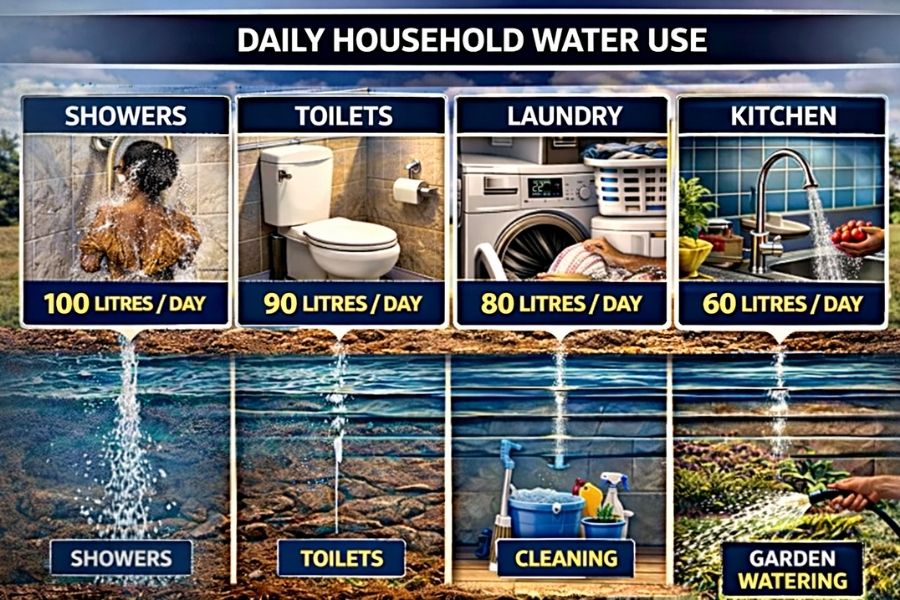
To understand daily demand properly, it helps to break the household down into actual usage categories.
1. Showers and baths
This is often one of the biggest daily indoor uses. Longer showers and frequent baths can increase daily demand quickly.
2. Toilet flushing
Toilets use more water than many homeowners realise, especially in larger families or homes with older, less efficient systems.
3. Laundry
Washing machines can make a noticeable contribution to total daily use, particularly in households that run multiple loads per day.
4. Kitchen use
Cooking, rinsing, dishwashing, and sink use usually form a smaller share than showers and toilets, but they still add up.
5. Handwashing and personal hygiene
These smaller uses happen many times each day and contribute steadily to the overall total.
6. Cleaning
Floor cleaning, surface cleaning, and general household washing all add to daily demand.
7. Outdoor use
This is where demand can rise sharply. Gardens, lawns, pressure washing, vehicle washing, and pool top-ups can easily push a normal household into a high-use category.
For many homeowners, outdoor use is the biggest hidden driver. A house may feel like an average family home indoors but behave like a much larger water consumer once the garden is included.
Water Use in Small, Medium, and Large Households
These examples help turn the theory into something more practical.
Small household example
A 2-person home with short showers, moderate laundry, efficient toilets, and little outdoor watering may use around 300 to 500 litres per day.
Medium household example
A 4-person family with normal showers, daily cooking, regular laundry, and average home use may sit closer to 600 to 900 litres per day.
Larger household example
A 5- or 6-person household with multiple bathrooms, frequent washing, more occupants at home during the day, and some garden watering may move beyond 1,000 litres per day.
High-demand property example
A home with a large garden, irrigation zones, a pool, multiple bathrooms, and higher comfort use can go far above 1,000 litres per day and may use several thousand litres on heavy-use days.
This is exactly why household water demand should always be measured against the actual property, not against a generic average found online.
Indoor vs Outdoor Water Demand
One of the most important distinctions in borehole planning is the difference between indoor demand and outdoor demand.
Indoor demand
This includes drinking, cooking, washing, bathing, toilets, laundry, and normal home cleaning. Indoor demand is usually more consistent throughout the year.
Outdoor demand
This includes gardens, lawns, irrigation, washing paved areas, car washing, filling water features, and pool-related use. Outdoor demand can vary dramatically by season and by property style.
Why does this distinction matter?
Because many homeowners want a borehole mainly to offset outdoor demand first. That is often where municipal bills climb fastest. A household may use a manageable amount of indoor water but then push costs much higher through irrigation or heavy outdoor use.
This makes boreholes especially attractive for homes with gardens. But it also means you need to understand your daily pattern properly. A borehole that easily supports indoor demand may feel very different once serious irrigation enters the picture.
That is one reason your live article How Much Does a Borehole Cost in South Africa? ties in naturally here. The financial case for a borehole often depends on whether the property’s total daily demand is high enough to justify the investment.
How to Estimate Your Own Household’s Daily Water Use
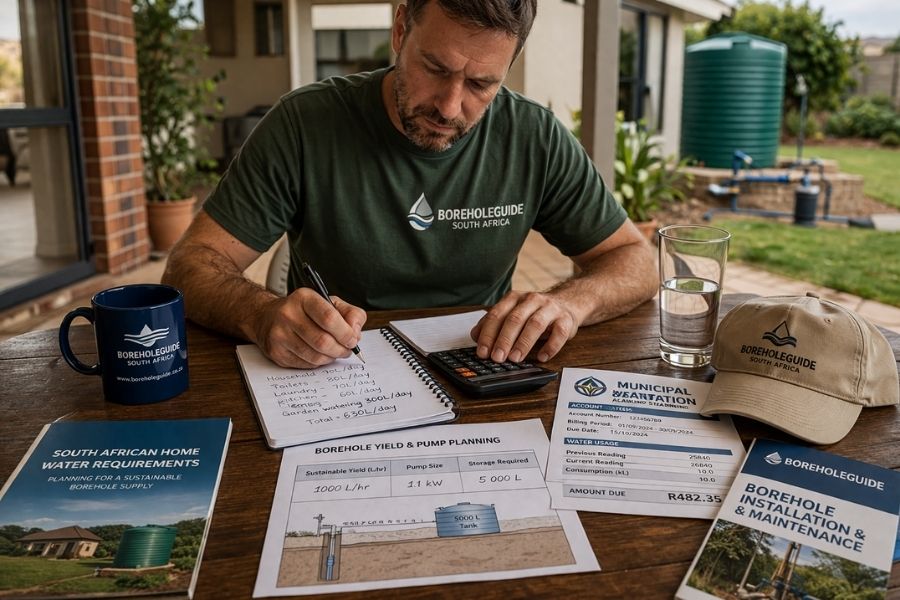
The best way to estimate your home’s daily water use is not to chase a perfect national average. It is to build a realistic estimate based on your own household.
Step 1: Start with the number of people in the house
Ask how many people regularly live in the home and how often they are home during the day.
Step 2: Estimate indoor use per person
A practical planning range of roughly 100 to 180 litres per person per day works for many ordinary homes, depending on habits and efficiency.
Step 3: Add shared household uses
This includes laundry, dishwashing, and general cleaning that may not be captured neatly in a simple per-person guess.
Step 4: Add outdoor demand separately
This is critical. Garden watering and irrigation can make a bigger difference than many people expect. Always estimate this separately instead of hiding it inside your indoor number.
Step 5: Think in normal days and peak days
Your system does not only need to survive average use. It also needs to cope with heavier-use days. A family gathering, hotter weather, or extra irrigation can change demand significantly.
Here is a simple planning example:
| Demand Item | Example Estimate |
|---|---|
| 4 people at 140 litres each | 560 litres per day |
| Laundry and cleaning margin | 100 litres per day |
| Moderate garden use | 200 litres per day |
| Total | 860 litres per day |
This kind of estimate is not exact science, but it is usually good enough to plan a practical home water system far better than pure guesswork.
What This Means for Borehole Sizing and Yield
Once you know your daily household water use, you can make much better decisions about your borehole system.
For example, if your home uses around 800 litres per day, that demand can be matched in different ways:
- a moderate-yield borehole pumping steadily into tanks
- a stronger-yield borehole supplying direct use and storage
- a mixed system where some demand stays on municipal water
This is why a household’s daily water use should always be viewed together with:
- borehole yield
- pump size
- storage tank capacity
- pressure system design
- seasonal demand changes
If you have not yet read it, this article should naturally connect you to How Much Water Can a Borehole Produce in South Africa?. That article helps answer the supply side of the same planning problem.
It also ties into Can Boreholes Run Dry in South Africa?, because a borehole that is pumped as though it can support a household using far more water than it realistically should can begin to show stress.
How to Reduce Household Water Use Without Sacrificing Comfort
One of the smartest ways to improve your borehole or backup water planning is not only to increase supply, but also to reduce waste.
Take shorter showers
This is one of the simplest ways to cut daily demand without major lifestyle pain.
Fix leaks quickly
Dripping taps, leaking toilets, and unnoticed plumbing losses can waste far more water than people realise.
Use efficient fittings and appliances
Lower-flow fittings, efficient washing machines, and more efficient toilets can reduce demand significantly over time.
Water gardens more intelligently
Outdoor use can easily be the biggest waste category. Smarter irrigation timing and better garden planning can make a major difference.
Use storage wisely
Tanks help separate supply from demand and make a modest-yield borehole much more useful.
Know your real usage pattern
Once you know whether your home is using 500 litres, 900 litres, or 1,500 litres per day, you can make much more intelligent system decisions.
This is also why your live maintenance article, Borehole Maintenance Checklist, matters. Good monitoring and maintenance help you catch waste, pressure issues, and early signs of system inefficiency before they become expensive problems.
Final Thoughts
So, how much water does a household use daily in South Africa?
There is no single fixed answer, but for practical planning purposes, many homes fall somewhere between a few hundred litres and well over 1,000 litres per day depending on household size, efficiency, and outdoor use.
The most important lesson is not to chase a one-size-fits-all number. It is to understand your own property properly.
Once you know how much water your home uses each day, you can make far better decisions about:
- whether a borehole is worth it
- what yield you actually need
- how large your storage should be
- what kind of pump setup makes sense
- how to manage the system sustainably
That is what turns daily household water use from a vague lifestyle question into a practical planning tool.
FAQs
How much water does a normal household use per day?
It depends on household size and lifestyle, but many homes use anywhere from roughly 300 to over 1,000 litres per day in practical real-world terms.
How much water does one person use per day at home?
A practical planning range is often around 100 to 180 litres per person per day for normal everyday household use, although efficient users may be lower and heavy users may be higher.
Does garden watering make a big difference?
Yes. Outdoor watering can push a household from moderate daily demand into a much higher use category very quickly.
Can a modest-yield borehole still supply a household?
Yes, especially if the home uses storage tanks and the system is designed around realistic daily demand instead of direct peak-only use.
Why is daily household water use important for a borehole?
Because it helps determine the borehole yield, pump size, storage capacity, and overall system design your property actually needs.
How can I estimate my home’s daily water use?
Start with the number of people in the home, estimate indoor use per person, add shared uses like laundry and cleaning, then add outdoor demand separately.
What should I read next on BoreholeGuide?
Good next reads are How Much Water Can a Borehole Produce in South Africa?, Borehole vs Municipal Water Costs in South Africa, and Can Boreholes Run Dry in South Africa?.