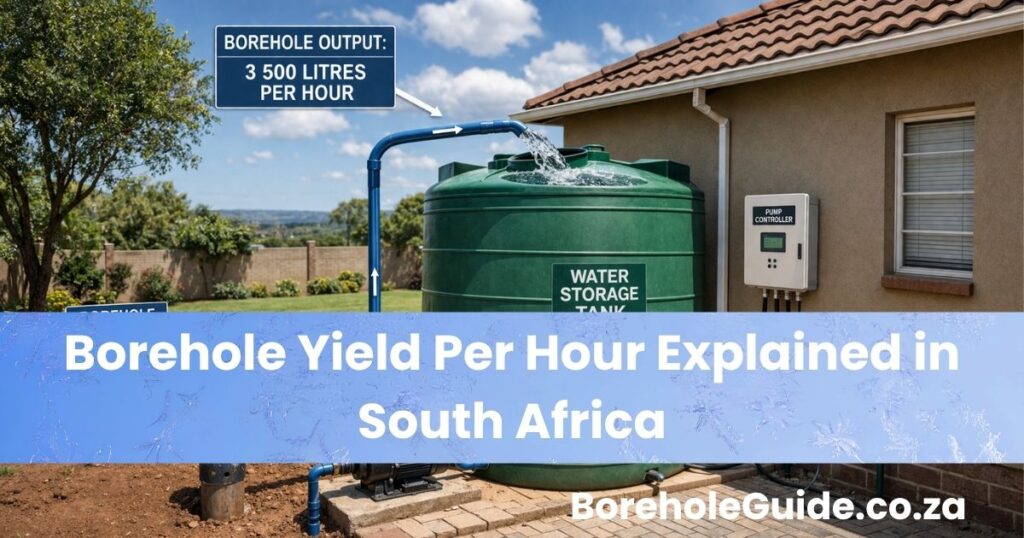
If you are researching boreholes, you will eventually come across a number like 500 litres per hour, 1,000 litres per hour, or 2,500 litres per hour. That number is usually the borehole’s yield per hour.
It sounds simple, but many homeowners misunderstand what it actually means.
They assume a borehole producing 1,000 litres per hour will always deliver that amount without interruption, in every season, under any pumping pattern. In reality, borehole yield per hour is one of the most useful borehole numbers you can know, but it only makes sense when you understand how it is measured, what affects it, and how it connects to your real water needs.
A borehole with a lower hourly yield can still be very useful if it is managed properly and connected to storage tanks. A borehole with a higher hourly yield is obviously more flexible, but that still does not mean it can be abused without limits. Yield is about sustainable supply, not fantasy supply.
This is why borehole yield per hour matters so much. It helps determine whether the borehole is suitable for household use, irrigation, storage filling, livestock, or a mixed residential setup. It also helps shape pump choice, tank size, usage patterns, and expectations.
If you have already read How Much Water Can a Borehole Produce in South Africa?, this article goes one level deeper. That article looks at the broader output question. This one explains what yield per hour actually means, how to interpret it, and how to use that number in practical planning.
Table of Contents
- Quick answer: what borehole yield per hour means
- What borehole yield actually is
- Why “per hour” matters
- How borehole yield is measured
- Common borehole yield per hour examples
- What counts as a good borehole yield?
- Yield per hour vs household water demand
- Why a lower-yield borehole can still work well
- What affects borehole yield per hour
- Yield and pump selection
- Signs your borehole yield may be dropping
- Final thoughts
- FAQs
Quick Answer: What Borehole Yield Per Hour Means
Borehole yield per hour means the amount of water a borehole can produce in one hour, usually expressed in litres per hour.
For example:
- 500 litres per hour means the borehole can supply about 500 litres in one hour
- 1,000 litres per hour means it can supply about 1,000 litres in one hour
- 2,000 litres per hour means it can supply about 2,000 litres in one hour
But the important part is this: that number is only useful when it reflects a sustainable pumping rate.
In other words, the best interpretation is not “how much water can come out in one burst,” but rather “how much water the borehole can supply per hour without being pushed beyond what it can realistically recover.”
What Borehole Yield Actually Is
Borehole yield is the practical water output of the borehole. It tells you how much water the borehole can provide over time.
That output depends on how much groundwater can flow into the borehole from the surrounding underground formation. A borehole does not create water. It taps into water-bearing zones underground and allows that water to enter the hole so it can be pumped out.
This means borehole yield depends on things like:
- the geology below the property
- the strength of the aquifer or fracture zone
- how quickly the borehole recharges during pumping
- how the borehole was drilled and completed
- how aggressively it is pumped
A stronger borehole usually has a better yield because the surrounding formation can keep feeding water into it more effectively. A weaker borehole may still produce water, but at a lower sustainable rate.
Why “Per Hour” Matters
Homeowners often ask, “How much water does a borehole produce?” But that question is incomplete unless you attach a time period to it.
That is why litres per hour matters.
If someone tells you a borehole “produces 10,000 litres,” that number means very little unless you know whether that is:
- per hour
- per day
- over a short pumping test
- under ideal conditions only
Yield per hour is one of the clearest ways to understand borehole performance because it gives you a usable rate. It allows you to compare the borehole against:
- your daily household demand
- your irrigation needs
- your tank filling requirements
- your pump size and pumping pattern
It also helps prevent unrealistic expectations. A borehole producing 800 litres per hour may be very useful for a home with tanks and sensible water management, but it may struggle if the owner expects it to behave like an unlimited municipal main.
How Borehole Yield Is Measured
Borehole yield is usually measured during or after drilling through a yield test or pumping test.
The basic idea is simple:
- water is pumped from the borehole
- the output is measured over time
- the water level behaviour is observed
- the recovery rate is also considered
This matters because a borehole may produce a high flow for a short burst and then weaken quickly. That is very different from a borehole that can maintain a stable output more steadily.
A useful yield assessment looks at more than just the immediate flow coming out of the pipe. It also considers:
- how fast the water level drops while pumping
- how well the borehole recovers
- whether the output is sustainable
- whether the yield matches the intended use
This is one reason your live article Can Boreholes Run Dry in South Africa? matters so much. A borehole that is over-pumped beyond its sustainable yield may seem fine at first and then begin to struggle.
Common Borehole Yield Per Hour Examples
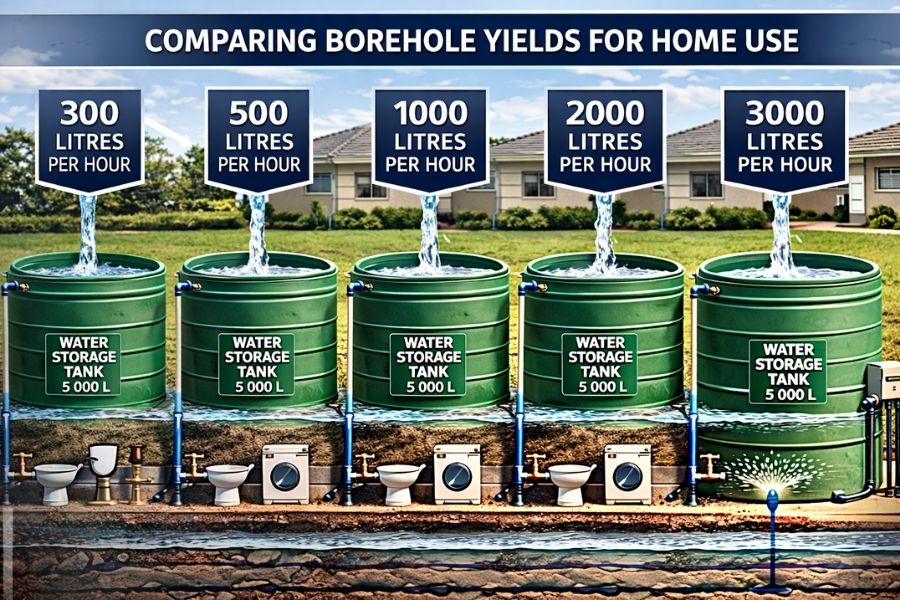
These examples help show how yield per hour works in practical terms.
| Borehole Yield | What It Means in Practice |
|---|---|
| 300 litres per hour | Modest output, often more suitable with storage and careful usage |
| 500 litres per hour | Useful for light residential support, especially with tanks |
| 1,000 litres per hour | Often workable for a household, especially with storage |
| 2,000 litres per hour | Strong domestic output for many home setups |
| 3,000+ litres per hour | Very strong output for many residential needs and beyond |
These examples should not be treated as universal guarantees. The same hourly yield can feel very different depending on:
- how many people live on the property
- whether the borehole supplies the whole house
- whether irrigation is included
- whether tanks are installed
- how often water demand peaks during the day
That is why one of the smartest things a homeowner can do is stop asking, “Is this yield good in general?” and start asking, “Is this yield good enough for my system?”
What Counts as a Good Borehole Yield?
A “good” borehole yield depends on the intended use.
For example, a borehole that only needs to fill storage tanks steadily throughout the day can be very useful even if the hourly yield is modest. A property expecting high simultaneous demand with no storage may need a stronger yield and a better-designed pressure system.
As a broad practical idea:
- low yield may still be usable with tanks and careful management
- moderate yield can often serve a normal household reasonably well
- strong yield gives more flexibility for household use, irrigation, and future needs
This is exactly why there is no single national number that defines a “good” borehole. BoreholeGuide’s live yield article already makes that clear: output must be judged against need, not just against a random benchmark.
If you want the bigger-picture version of this topic, see How Much Water Can a Borehole Produce in South Africa?.
Yield Per Hour vs Household Water Demand
This is where borehole yield per hour becomes truly useful.
Imagine two different homes:
Home A
- small family
- moderate indoor water use
- little to no irrigation
- has storage tanks
A moderate hourly yield may work perfectly well for this setup.
Home B
- larger family
- heavy outdoor irrigation
- multiple bathrooms
- expects strong pressure at all times
- no tank-based buffer
The same borehole may feel weak in this second setup, even though the hourly yield number itself has not changed.
This is why yield per hour must always be interpreted together with:
- daily water demand
- peak demand periods
- storage capacity
- pump selection
- system design
A borehole is not judged only by how much water it can produce. It is judged by whether that production matches how the property actually uses water.
Why a Lower-Yield Borehole Can Still Work Well
One of the biggest mistakes homeowners make is assuming that a lower hourly yield automatically means the borehole is not worth having.
That is not always true.
A lower-yield borehole can still work very well when the system is designed intelligently. For example:
- the borehole pumps slowly into storage tanks
- the household uses the stored water later through a pressure system
- peak household demand is separated from borehole extraction
- water use is monitored and managed sensibly
This kind of setup can make a modest-yield borehole surprisingly valuable. In many cases, the real difference between a “weak” borehole and a useful borehole is not only the yield itself. It is whether the system around it has been planned properly.
This is also where your live pump content becomes relevant. If you have not read them already, this article should naturally connect readers to What Pump Is Best for a Borehole in South Africa? and Submersible vs Surface Borehole Pumps in South Africa.
What Affects Borehole Yield Per Hour
Several factors can affect how much water a borehole can produce per hour.
1. Geology
The underground formation is one of the biggest factors. Some aquifers and fracture zones are stronger than others.
2. Borehole depth
Depth can influence yield, but deeper is not automatically better. What matters is whether the borehole intersects a productive water-bearing zone.
3. Borehole construction quality
The way the borehole is drilled, cased, and completed can affect long-term performance.
4. Groundwater recharge
Some boreholes recover faster than others depending on rainfall patterns, aquifer conditions, and how the groundwater system behaves.
5. Pumping pattern
A borehole can appear weaker if it is pumped too hard or too continuously.
6. Seasonal conditions
Some boreholes perform better after good recharge periods and more modestly in drier conditions.
7. Nearby abstraction
Other boreholes in the same area can sometimes place pressure on the same groundwater system.
This is one reason your live article Can Boreholes Run Dry in South Africa? is such an important supporting piece. Yield is not a fixed magic number that never changes. It can be affected by how the borehole and the aquifer are used over time.
Yield and Pump Selection
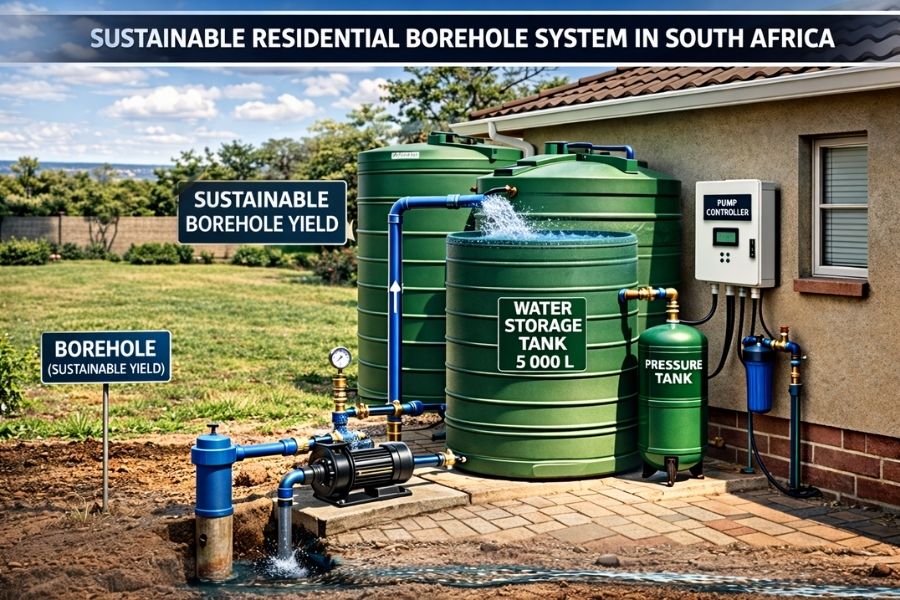
The pump should match the borehole’s real yield, not just the homeowner’s ideal output.
If the pump is too aggressive for the borehole, it can:
- draw water down too quickly
- cause unstable supply
- pull air during pumping
- stress the pump and system
- make the borehole seem weaker than it really is
This is why yield and pump choice always belong together. A correctly sized pump makes far better use of the borehole than an oversized one chosen simply because it sounds powerful.
For that reason, this article should also naturally support your live article What Pump Is Best for a Borehole in South Africa?.
Signs Your Borehole Yield May Be Dropping
Some boreholes maintain fairly stable performance. Others begin to show warning signs if the yield is under pressure or the system is not being managed properly.
Watch for signs such as:
- lower flow than before
- slower tank filling
- reduced pressure
- air in the system
- pump cut-outs during heavy use
- longer recovery times between pumping periods
These signs do not always mean the aquifer is failing. Sometimes the real problem is pump wear, control issues, or increased water demand on the property. But declining yield behaviour should never be ignored.
Your live maintenance article fits well here: Borehole Maintenance Checklist. Regular monitoring is one of the best ways to catch yield-related problems early.
Final Thoughts
So, what does borehole yield per hour actually mean?
It means the amount of water a borehole can produce in one hour, usually measured in litres per hour. But more importantly, it helps you understand what the borehole can supply in practical, real-world terms.
A borehole yield number is not just a technical detail. It is one of the most important planning numbers in the entire system. It affects whether the borehole can meet household needs, whether storage tanks are necessary, how the pump should be sized, and how the system should be managed over time.
The smartest way to use this number is not in isolation, but together with:
- your daily water use
- your peak demand times
- your storage setup
- your pump design
- your borehole’s recovery behaviour
That is what turns “yield per hour” from a confusing technical phrase into a practical number you can actually use.
FAQs
What does borehole yield per hour mean?
It means the amount of water a borehole can produce in one hour, usually measured in litres per hour.
Is a higher borehole yield always better?
Usually it gives more flexibility, but the real question is whether the yield matches your property’s actual water needs and system design.
Can a low-yield borehole still be useful?
Yes. A lower-yield borehole can still work very well if it pumps into storage tanks and the system is designed properly.
How is borehole yield measured?
It is usually measured through a pumping or yield test that looks at output, water-level behaviour, and recovery.
Why does my borehole yield seem different at different times?
Yield can be affected by seasonal conditions, pumping patterns, recharge, demand, and system issues.
Does pump size affect yield per hour?
The pump does not create groundwater, but the wrong pump can make borehole performance worse if it is too aggressive for the borehole’s sustainable yield.
What should I read next on BoreholeGuide?
Good next reads are How Much Water Can a Borehole Produce in South Africa?, Can Boreholes Run Dry in South Africa?, and What Pump Is Best for a Borehole in South Africa?.