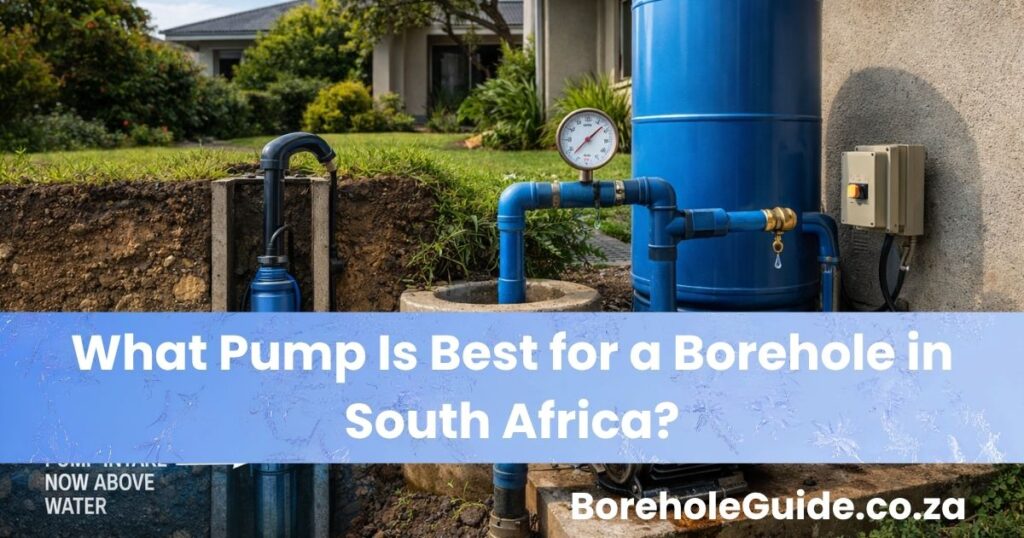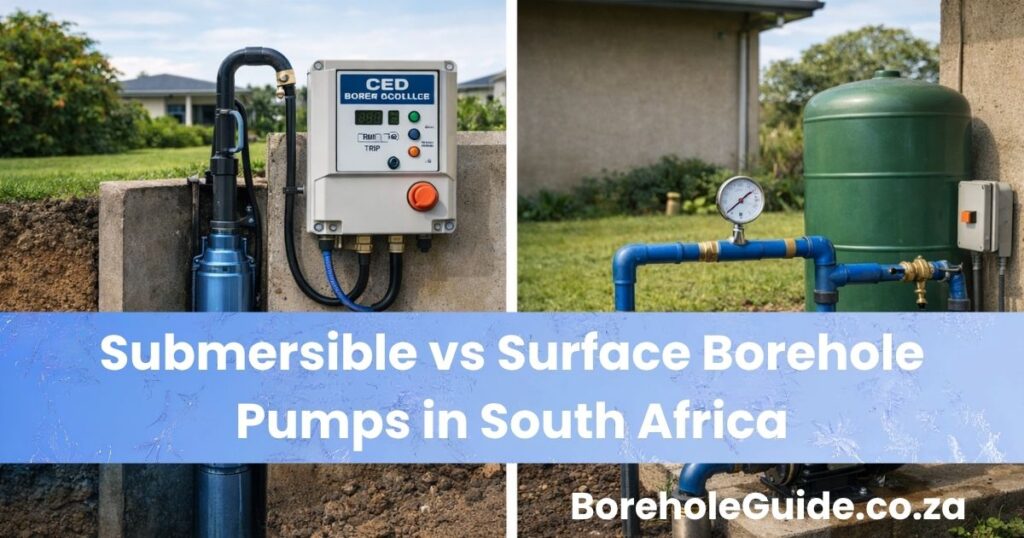
If you are planning a borehole system, one of the most important decisions you will make is choosing the right pump. And for most homeowners, that choice comes down to one comparison: submersible vs surface borehole pumps.
At first glance, the answer seems simple. One pump goes inside the borehole. The other stays above ground. But in real-world South African borehole setups, the decision is more important than that. The wrong pump can lead to poor pressure, wasted electricity, unreliable performance, unnecessary repairs, and even damage to the overall system design.
That is why this is not just a technical equipment question. It is a system-planning question.
For most residential boreholes in South Africa, a submersible pump is usually the better option. It is generally the standard choice for deeper boreholes and full domestic water systems. A surface pump, on the other hand, may still make sense in specific situations such as shallow lifting, pressure boosting, or moving water from storage tanks. The key is understanding what each pump does best and where each one fits.
If you have already read What Pump Is Best for a Borehole in South Africa?, this article takes that topic one step further by comparing the two main pump types directly. It also pairs well with Borehole Pump Installation Cost in South Africa because pump type influences both price and long-term running costs.
In this guide, we will compare submersible and surface borehole pumps in practical terms. You will learn how they work, where they are best used, what their limitations are, which one is usually best for a home in South Africa, and how to avoid the most common pump selection mistakes.
Table of Contents
- Quick answer: which pump is better?
- What is a submersible borehole pump?
- What is a surface borehole pump?
- Main differences between submersible and surface pumps
- When a submersible pump is the better choice
- When a surface pump makes sense
- Cost comparison
- Efficiency, pressure, and performance
- Maintenance and lifespan
- Common mistakes when choosing between them
- Best option for most South African homes
- Final thoughts
- FAQs
Quick Answer: Which Pump Is Better?
For most South African residential boreholes, a submersible pump is usually the better choice.
That is because submersible pumps are designed to work below the water level inside the borehole and are much better suited to deeper lifting conditions. They are generally the standard solution for household borehole systems that need reliable water delivery from underground to the surface.
A surface pump is usually not the best main extraction pump for a typical deeper borehole. However, it can still be very useful in certain roles, such as:
- pumping water from a storage tank
- boosting household pressure
- handling shallower lifting requirements
- supporting a system that is not pumping directly from a deep borehole
So the short answer is this:
Submersible pumps are usually best for the borehole itself. Surface pumps are often best as support or booster pumps in the wider water system.
What Is a Submersible Borehole Pump?

A submersible borehole pump is a pump that is installed down inside the borehole, below the water level. Instead of trying to pull water upward by suction, it pushes water to the surface from below.
This design makes it especially suitable for boreholes, particularly where:
- the water level is relatively deep
- the borehole is used for domestic water supply
- consistent pressure and flow are important
- the property wants a permanent, reliable system
Submersible pumps are widely used in South Africa because they work well in the kind of lifting conditions many residential boreholes require. They are also the most common pump type referenced in your existing cost and installation articles, which already position them as the standard option for most home borehole systems.
How a submersible pump works
The pump sits below the water and pushes water upward through the delivery pipe. Because it works from inside the water column rather than trying to pull from the surface, it handles deeper applications much better than a standard surface pump.
Main strengths of submersible pumps
- better for deep boreholes
- better suited to full domestic supply systems
- generally efficient for borehole extraction
- less dependent on suction limitations
- common and proven in residential borehole setups
What Is a Surface Borehole Pump?

A surface pump is a pump that stays above ground and pulls water from the source. Unlike a submersible pump, it is not installed down inside the borehole.
Surface pumps can be useful, but they are more limited when it comes to deeper borehole lifting. This is why they are not usually the first choice for the main extraction pump on a typical residential borehole in South Africa.
That said, they still have an important role in many systems.
Where surface pumps are useful
- moving water from tanks to the house
- boosting water pressure
- supporting shallow water transfer applications
- working in systems where the borehole first feeds storage
So while a surface pump is usually weaker as a direct deep-borehole extraction solution, it can still be extremely useful as part of the total water system design.
Main Differences Between Submersible and Surface Pumps
| Feature | Submersible Pump | Surface Pump |
|---|---|---|
| Installation position | Inside the borehole below water level | Above ground |
| Main action | Pushes water upward | Pulls water upward |
| Best for deep boreholes | Yes | No, usually limited |
| Best for household borehole supply | Usually yes | Only in certain setups |
| Best for tank boosting | Not usually the main purpose | Yes, often useful |
| Noise at surface | Usually lower | Usually more noticeable |
| Typical residential role | Main borehole extraction pump | Booster or transfer pump |
This comparison helps show why the two pump types are not always direct competitors. In many good residential systems, they actually play different roles rather than replacing each other completely.
When a Submersible Pump Is the Better Choice
A submersible pump is usually the better choice when the borehole is intended to be a serious water source for the property.
1. The borehole is relatively deep
Most residential boreholes in South Africa are far better served by a pump designed for deeper lifting conditions. This is one of the biggest reasons submersible pumps are the standard choice.
2. The borehole will supply the house directly
If the system is expected to support taps, toilets, showers, washing machines, and outdoor use, a submersible pump is usually the stronger starting point.
3. The property wants reliable long-term borehole extraction
For a permanent domestic system, submersible pumps are generally more appropriate than trying to force a surface pump into a role it is not best suited for.
4. The borehole has a properly planned pressure or storage setup
Submersible pumps work especially well when integrated into a broader system that may include storage tanks, controllers, filtration, and pressure management.
This is one reason your live post on How Borehole Drilling Works: Step-by-Step Guide naturally supports this article. It already explains that modern boreholes commonly use submersible pumps to move water to the surface.
When a Surface Pump Makes Sense
A surface pump may still be the right choice in specific situations, but usually not as the main pump for a typical deeper residential borehole.
1. You are pumping from a storage tank, not directly from the borehole
This is one of the best uses for a surface pump. If the borehole fills a tank first, a surface pump can then boost or transfer water to the house.
2. You need pressure boosting
Where the main issue is household pressure rather than deep underground extraction, a surface pressure pump can be very useful.
3. The lifting depth is shallow
If the system is not dealing with typical deep borehole conditions, a surface pump may be practical.
4. The setup is more about distribution than extraction
Some systems use the borehole pump to fill storage slowly, then rely on another above-ground pump for day-to-day water delivery. In that case, a surface pump still plays a meaningful role.
So surface pumps are not “bad.” They are simply often used for a different part of the water system than the main borehole extraction task.
Cost Comparison
Cost is one of the main reasons homeowners compare submersible and surface pumps. On paper, a surface pump may seem cheaper at first. But the better financial decision depends on whether the pump is actually suitable for the job.
Your live pump cost article already reflects this clearly:
- submersible borehole pumps are the most common and usually better for deeper boreholes
- surface pumps are generally cheaper upfront but more limited in application
In broad residential terms:
| Pump Type | Typical Cost Range | General Use |
|---|---|---|
| Submersible pump | R6,000 – R15,000 | Main borehole extraction for deeper domestic systems |
| Surface pump | R3,000 – R10,000 | Tank transfer, boosting, or shallower applications |
The mistake is assuming that lower upfront price automatically means better value. If a cheaper surface pump cannot do the job your borehole system actually requires, it becomes the more expensive decision in practice.
For the broader cost picture, this article should also connect readers to Borehole Pump Installation Cost in South Africa and Hidden Costs of Borehole Drilling Homeowners Forget.
Efficiency, Pressure, and Performance
When comparing borehole pumps, performance matters just as much as purchase price.
Submersible pump performance
Submersible pumps are usually more effective for deep lifting because they push from below. That makes them a much better fit for typical borehole conditions where the water level may be far below the surface.
Surface pump performance
Surface pumps can work well in the right scenario, but they are usually more limited for deep suction. They are often more appropriate as booster pumps or for moving already-stored water.
Pressure matters too
Many homeowners think only in terms of “Can the pump move water?” But the real question is also whether the system can provide practical, comfortable pressure for daily use. A properly designed borehole setup often includes not just the main pump, but also tanks, pressure vessels, controllers, and protection equipment.
That is why the best answer is not always one pump on its own. Sometimes the best answer is a combination system built around the right roles for each component.
Maintenance and Lifespan
Both submersible and surface pumps require maintenance, but their real-world maintenance experience is not identical.
Submersible pumps
These pumps are out of sight down in the borehole, which can be a benefit in terms of noise and exposure. But when something does go wrong, access can be more involved because the pump must be removed from the borehole for servicing or replacement.
Surface pumps
These are easier to access physically because they sit above ground. However, they are also more exposed to weather, environmental conditions, and daily wear in some installations.
The more important point is this: the wrong pump choice usually creates more maintenance trouble than the pump type itself. A poorly matched pump will always cause more headaches than a correctly chosen one.
This is where your live article Borehole Maintenance Checklist becomes an important supporting link. Pump life, system checks, and routine monitoring all matter for long-term performance.
Common Mistakes When Choosing Between Them
Choosing on price alone
A surface pump may look cheaper upfront, but if the system really needs a submersible pump, that “saving” can turn into poor performance and expensive corrections.
Using a surface pump as the main solution for a deep borehole
This is one of the clearest setup mistakes. A surface pump is often simply not the best tool for the job when real deep lifting is required.
Ignoring the borehole’s actual yield
Even the correct pump type must still be sized properly. The pump should match the borehole’s sustainable output, not the homeowner’s wish list.
Not thinking about the full water system
The right answer may not be “submersible or surface” in a strict all-or-nothing way. In some homes, the best solution is a submersible pump in the borehole plus a surface pressure pump for distribution from storage.
Skipping the bigger financial picture
Pump choice influences installation cost, energy use, maintenance, and future repairs. That is why it ties directly into existing BoreholeGuide content on costs and hidden system expenses.
Best Option for Most South African Homes
For most residential homes in South Africa, the best answer is this:
Use a submersible pump as the main borehole extraction pump.
Then, if needed, use a surface booster or pressure pump as part of the storage and delivery side of the system.
This kind of setup makes practical sense because:
- the submersible pump handles the deep extraction role properly
- the system can fill tanks steadily and more safely
- a pressure pump can improve household water delivery
- the total system becomes more flexible and easier to manage
That is often a better design than trying to force one pump to do everything badly.
If readers are still deciding whether their property is even suitable for a borehole system, this article should also point them toward Signs Your Property Has Groundwater in South Africa.
Final Thoughts
So, when comparing submersible vs surface borehole pumps, which one is best?
For the borehole itself, a submersible pump is usually the better choice. It is designed for deeper borehole conditions, is far more suitable for typical household extraction needs, and is generally the standard option for residential borehole systems in South Africa.
A surface pump still has a role, but usually as a booster, transfer pump, or support component rather than the main deep-borehole extraction pump.
The smartest way to choose is not by asking which pump is “stronger” in general. It is by asking which pump is right for:
- your borehole depth
- your water level
- your property’s water demand
- your system design
- your budget and long-term operating needs
For most homes, that answer starts with a correctly sized submersible pump and a properly planned support system around it.
FAQs
What is the main difference between a submersible and a surface borehole pump?
A submersible pump is installed inside the borehole below the water level and pushes water upward. A surface pump stays above ground and pulls water from the source.
Which pump is better for a deep borehole?
A submersible pump is usually much better for a deep borehole because it is designed for deeper lifting conditions.
Is a surface pump cheaper than a submersible pump?
Usually yes in upfront purchase price, but it is not always the better value if the system really needs a submersible pump.
Can I use a surface pump for a borehole at home?
Sometimes, but usually not as the main pump for a typical deeper residential borehole. It is more often used for boosting pressure or moving water from tanks.
Do some homes use both types of pumps?
Yes. Many well-designed systems use a submersible pump in the borehole and a surface booster pump for household pressure or tank distribution.
Which pump is best for most South African homeowners?
For most homes, a correctly sized submersible borehole pump is the best main pump choice.
What should I read next on BoreholeGuide?
Good next reads are What Pump Is Best for a Borehole in South Africa?, Borehole Pump Installation Cost in South Africa, and Borehole Maintenance Checklist.